GlucoPril Official Website › Blog › A Glucose Name
A Glucose Name On A Circulation Formula
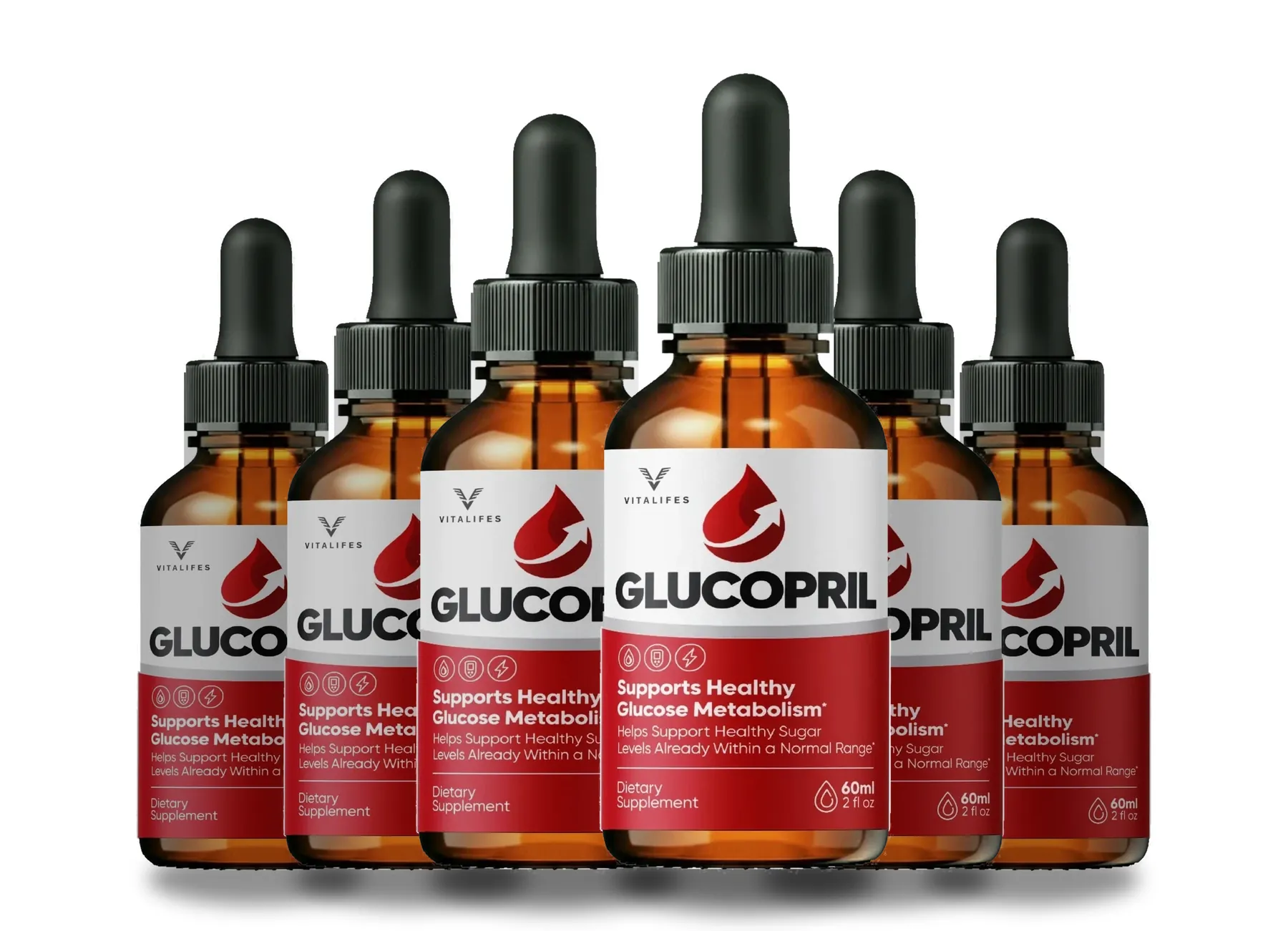
The front of this bottle sells glucose. The seven plants on its own ingredient graphic are the European venoactive set, and their trials measured ankles. Neither half is dishonest on its own. Together they are the single most useful thing a buyer can know before paying.
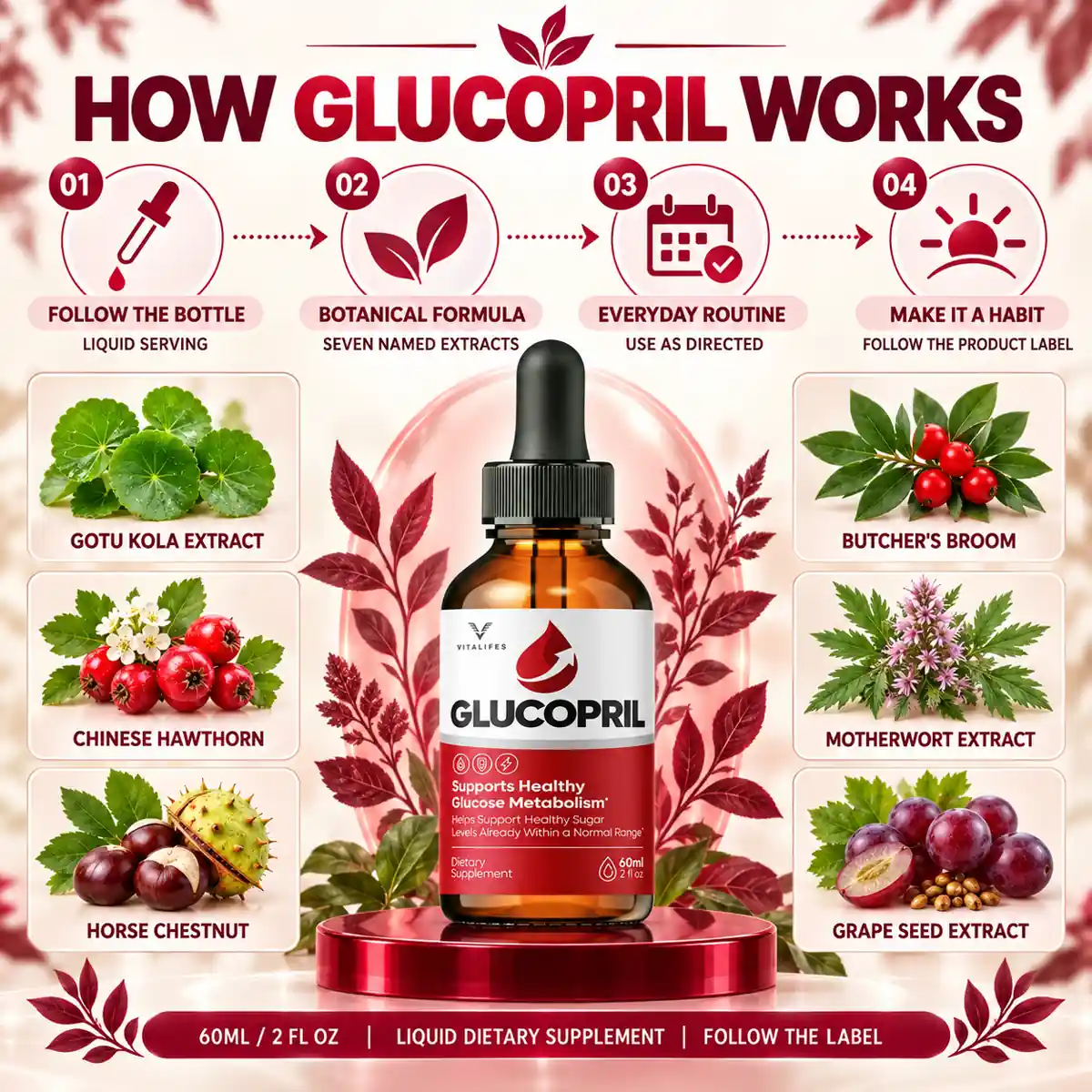
- Six of the seven plants on this label belong to the European venoactive group used in chronic venous disease.
- That literature measures ankle circumference, leg volume, capillary filtration and heaviness at the end of the day.
- The one pooled glucose result across the whole citation set belongs to grape seed, at 2.01 mg/dL of fasting plasma glucose with HbA1c unchanged.
- A front panel is allowed to say “supports healthy glucose metabolism” without any trial of the finished product behind it.
- The mismatch is worth knowing about before buying, and it does not require anybody to have lied.
The seven plants, and where their evidence sits
Start with the list, because everything else follows from it. The seller’s own ingredient graphic names gotu kola, Chinese hawthorn, horse chestnut, stone root, motherwort, butcher’s broom and grape seed, in that order.
Anybody who has read around chronic venous disease will recognise five of those immediately. Gotu kola, horse chestnut, butcher’s broom and grape seed are the standard venoactive set in European practice, and hawthorn sits just beside them in the cardiovascular literature.
| Plant on this label | Where its trial literature sits | Primary outcome measured |
|---|---|---|
| Gotu kola | Venous hypertension and microangiopathy | Ankle oedema, capillary filtration |
| Chinese hawthorn | Chronic heart failure, and one blood pressure trial | Symptom scores, exercise tolerance, blood pressure |
| Horse chestnut | Chronic venous insufficiency | Leg volume, end-of-day heaviness |
| Butcher’s broom | Chronic venous disease | Leg volume, heaviness, tingling |
| Grape seed | Cardiovascular risk markers, and one glycaemic meta-analysis | Blood pressure, flow-mediated dilation, fasting glucose |
| Motherwort | Obstetric care, by injection | Blood loss after delivery |
| Stone root | A single indexed laboratory record | Nothing in people |
Seven plants, and six of the seven have their evidence in circulation rather than in glucose handling.
The table is not an argument. It is a list of what the trials behind each plant chose to measure, which is a matter of record rather than of interpretation.
What the venoactive literature actually is
This is a real field with real evidence in it, and dismissing it would be as wrong as overselling it. The Cochrane review of phlebotonics for venous insufficiency is the umbrella assessment of the whole class, and it exists because enough randomised trials of these preparations have been run to be worth pooling.
The ESVS 2022 clinical practice guidelines on chronic venous disease go further and describe how a vascular service actually uses them, which is the sort of recognition very few botanical categories achieve. A 2026 critical appraisal sets the evidence for venoactive drugs against those international guidelines directly.
What those trials put numbers on
Ankle circumference, measured with a tape. Leg volume, measured by water displacement. Capillary filtration rate, measured with a plethysmograph. Subjective heaviness, tingling and cramping, scored on a questionnaire. The ten-trial meta-analysis of Ruscus preparations is a good example of the shape: individual venous symptoms and oedema, pooled across double-blind placebo-controlled trials.
- These are meaningful outcomes to anybody who has them.
- They are measured in the lower limb, at the end of the day, over weeks.
- They are not glucose outcomes, and nobody in that literature claims they are.
- The doses involved are hundreds of milligrams of a single standardised extract.
- Several of these preparations are prescribed in Europe rather than sold as supplements.
What the front panel is permitted to say
Now the other half. A dietary supplement may make a structure and function claim — a sentence about supporting a normal bodily process — and may not claim to treat, cure or prevent a disease. That rule shapes every word on the front of this bottle.
| What the front panel prints | What that sentence is permitted to mean |
|---|---|
| GLUCOPRIL | A brand name. Names are not claims and carry no evidential burden. |
| Supports Healthy Glucose Metabolism | A structure and function claim about a normal process. It is not a claim to lower anything, and it does not require a trial of the finished product. |
| Helps Support Healthy Sugar Levels Already Within a Normal Range | A maintenance claim, in people whose readings are already normal. The qualifying clause is doing most of the work in that sentence. |
| Dietary Supplement | A regulatory category that reaches the market without pre-market approval. |
Read together, the panel promises maintenance of a normal state rather than a change to an abnormal one.
Read the second sentence again with the qualifying clause in view. “Already within a normal range” describes who the product is for, and it is a smaller group than the one reading the page. That phrase appears on almost every bottle in this category and almost nobody notices it.
So the panel is compliant. It is also, read carefully, a much weaker promise than a name like this one implies, and the gap between the name and the sentence is where most of the misunderstanding in this category lives.
The one place the two literatures touch
There is a bridge and it is narrow enough to describe precisely. A meta-analysis of 50 randomised controlled trials of grape seed extract found fasting plasma glucose 2.01 mg/dL lower than control, with HbA1c unchanged.
That is a real pooled result from a large evidence base, and it is two milligrams per decilitre. A fasting reading moves by more than that between two mornings in the same week for reasons that have nothing to do with a supplement.
It is also grape seed at whatever doses those 50 trials used, not grape seed as one of seven plants sharing a blend total reported at about 121 mg. The bridge exists; it will not carry much weight.
A network meta-analysis of six herbs used for glycaemic status is the better reference for what a plant with genuine glycaemic evidence looks like, and none of the six is on this label.
Order GlucoPril knowing which literature is underneath it
Seven named botanical extracts with a real trial record, and a website that says what each of those trials measured rather than what a front panel implies.
Price at checkout · one payment, no subscription · money-back guarantee as printed at the checkout
Order GlucoPril On The Official Website2 drops a day after a meal · 60 ml a bottle · lot GLU-26/GL-2779
Why this combination keeps appearing
The commercial logic is not mysterious. These ingredients are available in bulk, well-tolerated, inexpensive and carry a plausible-sounding story about small blood vessels that can be told without making a prohibited claim.
Small blood vessels are also genuinely involved in the long-term picture of raised glucose, which is why a sentence connecting the two can be written without anybody being caught out. Microvascular damage is a real complication. Supporting microcirculation is a real thing to study. Neither of those facts makes a leg trial into a glucose result.
And a botanical liquid is cheap to produce and easy to brand. The path from “these plants support microcirculation” to a bottle called GlucoPril is short, and no step along it requires an outright false statement.
A weight for each plant. With seven amounts printed, a reader could compare each one against the dose its own trials used and decide. Without them, the comparison stops at a blend total reported by marketplace listings rather than by the bottle.
What it means for somebody holding the bottle
Three practical consequences, in order of how much they matter.
First, judge it on what it contains rather than on what it is called. If heavy legs at the end of a long day are the complaint, the ingredient list is at least pointed in the right direction, even at an unstated amount. If a fasting reading is the complaint, the ingredient list is pointed somewhere else.
Second, set your expectations from the trial doses rather than from the front panel. The ingredients page prints all seven of them.
Third, keep the measurement discipline either way. A twelve-week way to test this on yourself is on this website, and it works regardless of which reading you were hoping to change.
What this is not an accusation of
Nothing here says the plants are inert. Five of the seven have randomised, placebo-controlled trials behind them and one of them has fifty.
Nothing here says the label is illegal. The two support sentences are the standard compliant phrasing for this category, and they are weaker than the name rather than stronger.
And nothing here says a buyer is being cheated. A bottle of well-studied botanicals at an unstated dose is the ordinary condition of this shelf, not an outlier on it. What separates a good purchase from a poor one is whether the buyer knew which literature they were buying into.
How to use the mismatch rather than be annoyed by it
- Write down the ingredient names from any bottle you are considering.
- Search each one with the word “trial” and note the primary outcome.
- If the outcomes cluster somewhere other than the product’s category, you have learned the most important thing about it in five minutes.
- Check whether a weight is printed for each ingredient. Without one, nothing above can be turned into a comparison.
- Decide on the ingredients rather than on the name, which is the only version of the decision you can actually defend.
That sequence works on every label in this category. The seven-check scorecard turns it into something you can run from a photograph of a panel, and it finishes by applying all seven checks to this bottle with four failures printed in the open.
References
- Martinez-Zapata MJ, Vernooij RW, Simancas-Racines D, et al. Phlebotonics for venous insufficiency. Cochrane Database Syst Rev. 2020;11(11):CD003229. PMID 33141449. https://pubmed.ncbi.nlm.nih.gov/33141449/
- De Maeseneer MG, Kakkos SK, Aherne T, et al. Editor's Choice - European Society for Vascular Surgery (ESVS) 2022 clinical practice guidelines on the management of chronic venous disease of the lower limbs. Eur J Vasc Endovasc Surg. 2022;63(2):184-267. PMID 35027279. https://pubmed.ncbi.nlm.nih.gov/35027279/
- Santiago FR, Grillo L, Amore M, et al. Venoactive drugs in the management of chronic venous disease: a critical appraisal of the evidence and comparison with international guidelines. Vascul Pharmacol. 2026;163:107614. PMID 42066876. https://pubmed.ncbi.nlm.nih.gov/42066876/
- Kakkos SK, Allaert FA. Efficacy of Ruscus extract, HMC and vitamin C, constituents of Cyclo 3 fort, on improving individual venous symptoms and edema: a systematic review and meta-analysis of randomized double-blind placebo-controlled trials. Int Angiol. 2017;36(2):93-106. PMID 28225220. https://pubmed.ncbi.nlm.nih.gov/28225220/
- Asbaghi O, Nazarian B, Reiner Z, et al. The effects of grape seed extract on glycemic control, serum lipoproteins, inflammation, and body weight: a systematic review and meta-analysis of randomized controlled trials. Phytother Res. 2020;34(2):239-253. PMID 31880030. https://pubmed.ncbi.nlm.nih.gov/31880030/
- Kumar S, Sharma SK, Mudgal SK, et al. Comparative effectiveness of six herbs in the management of glycemic status of type 2 diabetes mellitus patients: a systematic review and network meta-analysis of randomized controlled trials. Diabetes Metab Syndr. 2023;17(8):102826. PMID 37451111. https://pubmed.ncbi.nlm.nih.gov/37451111/