GlucoPril Official Website › Blog › Does GlucoPril Work
Does GlucoPril Work? What the Research Behind Its Plants Shows
Does GlucoPril work? No published trial has tested the finished GlucoPril blend, so there is no direct answer. Its seven plants were studied one at a time, mostly for leg-vein measures. Grape seed has one small pooled result: 2.01 mg/dL lower fasting glucose across 50 trials, with HbA1c unchanged. The label claims support for normal function only.
Nobody has published a trial of the finished GlucoPril blend. Its seven plants have been studied one at a time, mostly for leg-vein measures. Grape seed has one small pooled glucose result: 2.01 mg/dL lower fasting glucose across 50 trials, with HbA1c unchanged. It does not lower blood sugar.
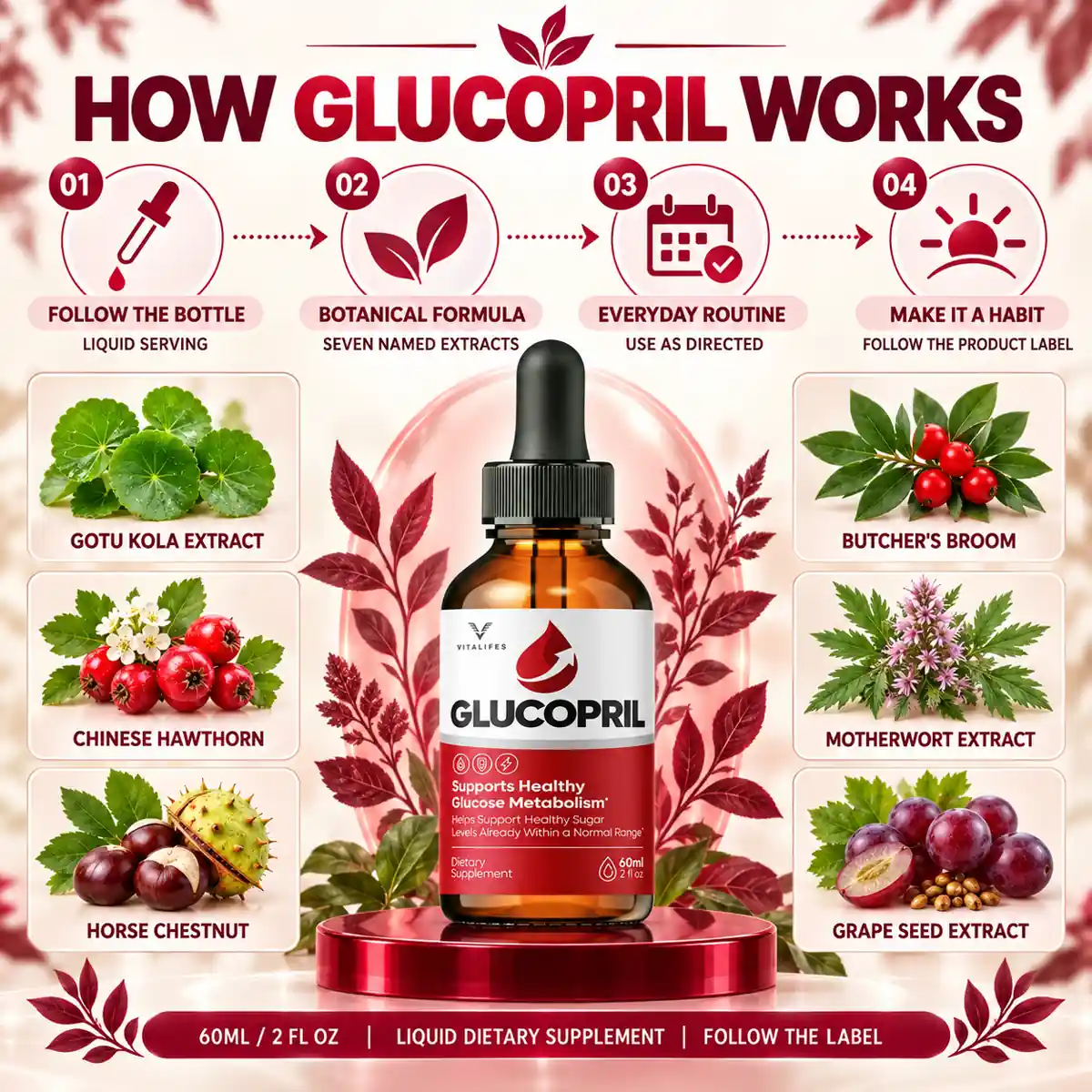
- No trial of the finished blend has been published. Everything cited is research on single plants.
- Six of the seven plants come from the European venoactive group, measured by leg volume, ankle size and capillary filtration.
- Grape seed is the only plant with a pooled glucose result: 2.01 mg/dL lower fasting plasma glucose across 50 randomised trials, HbA1c unchanged.
- Stone root has no human trial. Every controlled motherwort study is an injection.
- Marketplace reports describe about 121 mg for all seven plants together; trial doses were far larger for single plants.
- The label claims support for normal function only. It does not say the drops lower blood sugar.
What does work mean on a supplement label?
A supplement label may describe how a nutrient or plant supports the normal structure or function of the body. It may not say the product treats, cures or prevents a disease. That rule explains the odd grammar on this bottle.
Take the first sentence: Supports Healthy Glucose Metabolism. Supports means it contributes to a process already happening. Healthy points to the normal process. Glucose metabolism means the body's handling of sugar as a system, not one particular reading.
The second sentence ends with Already Within a Normal Range. That phrase is the limit. A product that supports levels already in range is not offering to bring a high reading down.
What have the seven GlucoPril plants been tested for?
This table comes from the research behind each plant, set beside the dose its own trials used. These are single-plant doses in trial conditions. They are not label amounts for this bottle.
| Plant | Dose in the trials | What the trials measured |
|---|---|---|
| Gotu kola | 90-180 mg/day | Ankle swelling and capillary filtration in venous hypertension |
| Chinese hawthorn | 900-1,200 mg/day | Heart failure symptoms, and blood pressure in one diabetes trial |
| Horse chestnut | 600 mg/day | Leg volume and end-of-day heaviness |
| Stone root | No human trial | Nothing in people; one laboratory screen names the plant |
| Motherwort | Injection only | Blood loss after delivery, given by injection in hospital |
| Butcher's broom | Dose not stated | Leg volume, heaviness and tingling in chronic venous disease |
| Grape seed | Pooled across doses | Fasting glucose, blood pressure and flow-mediated dilation |
Doses and outcomes as listed in the trial summaries on this website.
Read the right-hand column slowly. Only one row mentions glucose. Most rows are about veins, legs or blood vessels.
Is there any blood sugar result at all?
Yes, one, and it is small. A meta-analysis pooled 50 randomised trials of grape seed extract. Fasting plasma glucose came out 2.01 mg/dL lower than control. HbA1c, the three-month measure a clinician watches, did not change.
Put plainly, that is a real published number and a modest one. It is not a reason to change a medicine, to skip a test or to expect your meter to read differently next week. Our page on what the label claims goes through the same number word by word.
Grape seed has also been studied against blood pressure and against how blood vessels widen. In every case the pattern is about vessels. The glucose result is the odd one out, and it is the one printed on the front of the bottle.
See the facts, then the price
The checkout shows the pack price and the guarantee window, which this page cannot quote because the seller sets them.
See today's price and guarantee
Disclosure: this website earns from orders placed through its checkout.
Why does a blood sugar name sit on leg-vein plants?
Six of the seven plants belong to the European venoactive tradition. Gotu kola, horse chestnut and butcher's broom were tested against swelling and heaviness. Hawthorn was tested mostly in heart failure. The most likely story is a formula built from a circulation template and sold under a glucose name.
A reader should hold two ideas at once. The vein research is real and published. It is also not about glucose. The label does not make a leg claim, and neither does this website, but the research shapes what the plants are known for.
How does GlucoPril work, step by step?
Two chains are proposed. The first runs from a plant, through a blood vessel, to a measure such as leg volume. It has the most evidence behind it. The second runs from grape seed to fasting glucose. It is real, published and very small.
The format adds a third question: how much arrives. A drop from a standard pipette is near 0.05 ml, so two drops is roughly a tenth of a millilitre out of sixty. Marketplace reports describe about 121 mg for all seven plants together. That figure is not on the label. Trials used 600 mg of horse chestnut alone and 900 mg a day of one hawthorn extract, so seven plants cannot each sit at those levels.
A fair counter-point exists. Liquids can absorb differently from capsules. But no strength is printed for any extract, so that point cannot be measured for this product.
Which GlucoPril benefits can you count on?
- A one-step habit: two drops after a meal.
- One payment per pack, with no subscription.
- A named order desk for tracking, changes and refunds.
- A lot code on the base to quote to that desk.
- A short ingredient list you can check against the bottle.
Searches for GlucoPril blood sugar support and blood sugar support benefits often expect more than that. Those five are things about buying and routine. They are true whatever the plants do, and the site's own list of GlucoPril benefits says so. Anything about a blood sugar reading is for a doctor and a test, not a bottle.
It does not say GlucoPril lowers blood sugar, and it is not FDA approved. Never replace a prescribed medicine with a supplement. Tell your prescriber about anything you add.
Frequently asked questions
Does GlucoPril really work?
No trial of the finished blend has been published, so nobody can say. The seven plants have single-plant research, mostly on leg veins, and grape seed has one small pooled glucose result.
How does GlucoPril work?
Two chains are proposed. The better supported one is about blood vessels and leg measures. The glucose chain rests on grape seed, whose pooled result is 2.01 mg/dL with HbA1c unchanged.
Does GlucoPril lower blood sugar?
No, and no dietary supplement may claim that. The label says it supports healthy glucose metabolism and sugar levels already within a normal range.
What does blood sugar support mean?
It is a label phrase for a product that supports normal function. It does not mean the product lowers a high reading or treats a disease.
What are the GlucoPril benefits?
The label claims two support sentences. Beyond the formula, the practical benefits are a one-step routine, one payment per pack and a named refund route.
Why is the evidence about legs and not glucose?
Six of the seven plants come from vein research, where trials measure ankle swelling, leg volume and heaviness. Grape seed is the one plant with a glucose result.
Sources we used
- The 50-trial meta-analysis of grape seed extract. https://pubmed.ncbi.nlm.nih.gov/31880030/
- A 16-trial blood pressure meta-analysis of grape seed. https://pubmed.ncbi.nlm.nih.gov/27537554/
- The dose- and duration-response analysis of grape seed. https://pubmed.ncbi.nlm.nih.gov/34798267/
- The Cochrane review of phlebotonics. https://pubmed.ncbi.nlm.nih.gov/33141449/
- The Cochrane review of horse chestnut seed extract. https://pubmed.ncbi.nlm.nih.gov/23152216/
- The dose-ranging trial of Centella's triterpenic fraction. https://pubmed.ncbi.nlm.nih.gov/11666125/
- The SPICE trial. https://pubmed.ncbi.nlm.nih.gov/19019730/
- The one hawthorn trial run in people with type 2 diabetes. https://pubmed.ncbi.nlm.nih.gov/16762125/
- NCCIH on diabetes and dietary supplements. https://www.nccih.nih.gov/health/diabetes-and-dietary-supplements
- A 2026 appraisal of venoactive drugs against the guidelines. https://pubmed.ncbi.nlm.nih.gov/42066876/
Our view
Does it work? We cannot honestly say yes, and we cannot honestly say no. What we can say is where the evidence sits: mostly in leg veins, with one small glucose number from grape seed.
That is not a bad product story. It is a mismatched one. The name points to glucose. The plants point to circulation. A buyer who understands that can make a calm choice, and one who does not may expect the wrong thing.
If you try it, give it the time the research took and write down what else you change. If a reading worries you, get it tested. Neither the drops nor this page can do that job.
Do not stop or change a prescribed medicine because of anything on this page. Ask the prescriber who set the dose.
Decide at your own pace
If a one-step daily routine suits you, the checkout shows today's price and the guarantee before you confirm.
See today's price and guarantee
Disclosure: this website earns from orders placed through its checkout.