GlucoPril Official Website › Blog › GlucoPril Ingredients
What Is in GlucoPril? The Ingredients List and the Missing Supplement Facts
Seven names, no weights. Here is the list, what each plant is and what you cannot learn from a label that stops at the names.
GlucoPril names seven botanical extracts: gotu kola, Chinese hawthorn, horse chestnut, stone root, motherwort, butcher's broom and grape seed. No amount is published for any of them, and no Supplement Facts panel ships with the product. The 121 mg blend total is a marketplace report, not a label figure.
What is the GlucoPril ingredients list?
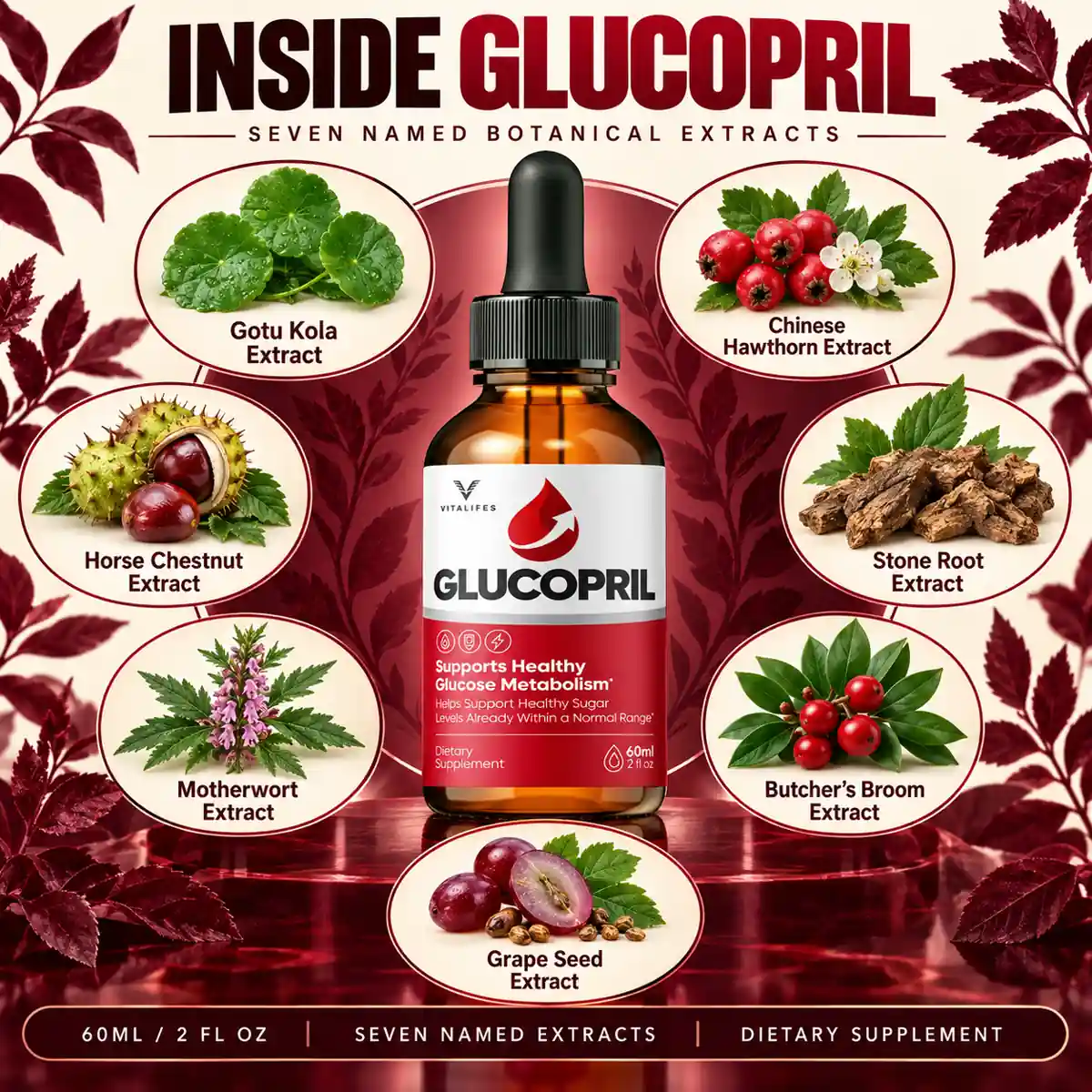
Seven botanical extracts, headed SEVEN NAMED BOTANICAL EXTRACTS on the seller's own graphic. This is the whole list, set out with the species and the plant part the artwork gives.
| # | As the artwork prints it | Species | Part |
|---|---|---|---|
| 1 | Gotu Kola Extract | Centella asiatica | Leaf |
| 2 | Chinese Hawthorn Extract | Crataegus | Fruit |
| 3 | Horse Chestnut Extract | Aesculus hippocastanum | Seed |
| 4 | Stone Root Extract | Collinsonia canadensis | Root |
| 5 | Motherwort Extract | Leonurus | Aerial parts |
| 6 | Butcher's Broom Extract | Ruscus aculeatus | Root and rhizome |
| 7 | Grape Seed Extract | Vitis vinifera | Seed |
Transcribed from the seller's ingredient graphic.
If you hold a bottle, count the names on that graphic. An extra name or a missing one means you are not looking at the product described here.
- Seven named botanical extracts, in a fixed order on the seller's graphic.
- No amount for any extract and no Supplement Facts panel; all fifteen supplied images were opened.
- Marketplace reports describe a proprietary blend of about 121 mg in total, for all seven plants together.
- No extract ratio or standardisation figure is printed beside any name.
- No named carrier liquid: anyone avoiding alcohol or animal-derived ingredients should ask the order desk.
- No vitamins or minerals are on the ingredient artwork.
Is there a GlucoPril Supplement Facts panel?
No. No panel ships with the product. All fifteen images in the asset pack were opened, and none carries one. No back label was supplied.
That is why this website has no supplement facts page for GlucoPril. A page built on a panel that does not exist would be a page about nothing. If you have the bottle in hand and it shows a panel, a photograph is welcome at the website address.
In place of label amounts, this site prints the dose each published trial used. Horse chestnut was tested at 600 mg a day, hawthorn at 900 to 1,200 mg a day, gotu kola at 90-180 mg a day. Those are single-plant doses from trials, not what is in your drops.
Compare the names, then the checkout
The seven names above are the check for any page claiming to sell this bottle. The checkout shows the price and the guarantee window.
See today's price and guarantee
Disclosure: this website earns from orders placed through its checkout.
What does the 121 mg blend figure mean?
Marketplace reports describe the actives grouped in a proprietary blend of about 121 mg. This figure did not come from the bottle. It is a total for all seven plants together, and a blend total tells you nothing about the share of any one.
It could mean one plant dominates and six are token additions, or seven plants in roughly equal parts. Those are very different bottles behind the same artwork. Since the order of names on a marketing graphic is whatever the designer chose, the order does not settle it either.
What does the word extract mean here?
Less than most people assume. An extract has a ratio and often a standardisation figure, such as aescin for horse chestnut or proanthocyanidins for grape seed. Those figures let a buyer compare one bottle with another. Neither appears on this artwork for any of the seven.
The marker compounds are what a laboratory would measure to confirm identity and strength: triterpenes for gotu kola, procyanidins for hawthorn, aescin for horse chestnut, none in general use for stone root, leonurine for motherwort, ruscogenins for butcher's broom and proanthocyanidins for grape seed.
Do the plant parts match the research?
Four rows line up with their research. Gotu kola leaf, horse chestnut seed, butcher's broom root and grape seed are each the tissue the trials used. Two rows do not.
- Chinese hawthorn. The label says fruit. The European trials ran on a leaf-and-flower preparation standardised to procyanidins. Same genus, different tissue.
- Motherwort. The label names the genus only. The controlled work used a different species as an injection, which is three steps from a drop.
- Stone root. No human trial exists, so there is nothing to match.
Horse chestnut has its own caution. NCCIH says raw seed is not safe to eat, and the studied material is the standardised extract.
What is not in the GlucoPril bottle?
Three things a reader might expect in a blood sugar formula are absent. The first is the group of herbs that dominates this category: berberine, cinnamon, gymnema, bitter melon and chromium. None of them is among the seven. Pages that list them describe a different formula sold under the same name.
The second is vitamins and minerals. One marketing panel mentions vital vitamins and minerals, and the ingredient artwork contradicts it. The third is a named carrier. Every liquid is mostly its base, and the artwork names none.
A search for blood sugar support ingredients or an ingredient blood sugar supplement may bring you pages for products with long lists of familiar names. Compare lists before you compare prices, and remember that a longer list is not a better one.
GlucoPril is a dietary supplement. It is not FDA approved, and no supplement is. Allergy to grapes or to any named plant is a reason to avoid it. Tell your doctor or pharmacist what you take.
Frequently asked questions
What are the GlucoPril ingredients?
Seven botanical extracts: gotu kola, Chinese hawthorn, horse chestnut, stone root, motherwort, butcher's broom and grape seed, in that order on the seller's graphic.
Is there a GlucoPril ingredients list with amounts?
No. The seller publishes no amount for any of the seven, and no Supplement Facts panel ships with the product.
What does the 121 mg figure mean?
Marketplace reports describe about 121 mg for the whole blend. It is a total for all seven plants, not a label amount, and it must not be split between them.
Does GlucoPril contain berberine or chromium?
No. Look-alike pages sell a formula with berberine, chromium, gymnema, bitter melon, cinnamon bark and alpha lipoic acid. None of those is among the seven here.
Is it vegan, and does it contain alcohol?
The artwork names no carrier liquid and no capsule shell. Ask the order desk what the base is before ordering if either matters to you.
Are the ingredients third-party tested?
No testing body is named on the pack and no report is published with it. The lot and certificate reference are filing references.
Sources we used
- NCCIH on horse chestnut. https://www.nccih.nih.gov/health/horse-chestnut
- NCCIH on grape seed extract. https://www.nccih.nih.gov/health/grape-seed-extract
- NCCIH on hawthorn. https://www.nccih.nih.gov/health/hawthorn
- The only indexed study naming Collinsonia canadensis. https://pubmed.ncbi.nlm.nih.gov/24105850/
- The multi-centre motherwort injection trial. https://pubmed.ncbi.nlm.nih.gov/31492552/
- The ten-trial meta-analysis of Ruscus preparations. https://pubmed.ncbi.nlm.nih.gov/28225220/
- The Cochrane review of hawthorn for heart failure. https://pubmed.ncbi.nlm.nih.gov/18254076/
- The dose-ranging trial of Centella's triterpenic fraction. https://pubmed.ncbi.nlm.nih.gov/11666125/
- The network meta-analysis of six herbs used for blood sugar. https://pubmed.ncbi.nlm.nih.gov/37451111/
- MedlinePlus on dietary supplements. https://medlineplus.gov/dietarysupplements.html
Our view
A good ingredient list gives you names, parts, strengths and a lab behind them. This one gives you names, and for four of the seven it also gives a plant part.
That is more honest than a page that invents numbers, and less useful than a real panel. If you like reading labels, this one invites a careful read and then a question to the seller. If you need a figure to compare bottles, this product cannot offer one.
Check the seven names against the bottle that arrives. That one step does more for your peace of mind than any seal.
Allergies, pregnancy and medicines are for a clinician to weigh. Do not decide them from a label alone.
Ready to check the bottle
When you order, hold the bottle that arrives against the seven names above. The checkout shows the price and the guarantee first.
See today's price and guarantee
Disclosure: this website earns from orders placed through its checkout.