GlucoPril Official Website › Blog › Reading A Label
Reading A Supplement Label That Carries No Amounts
Seven plant names and no weights is a common shape in this category, and it is the shape of this bottle. It is not useless information. Here is exactly what a name without a number tells you, what it withholds, and how to get the most out of the half you have been given.
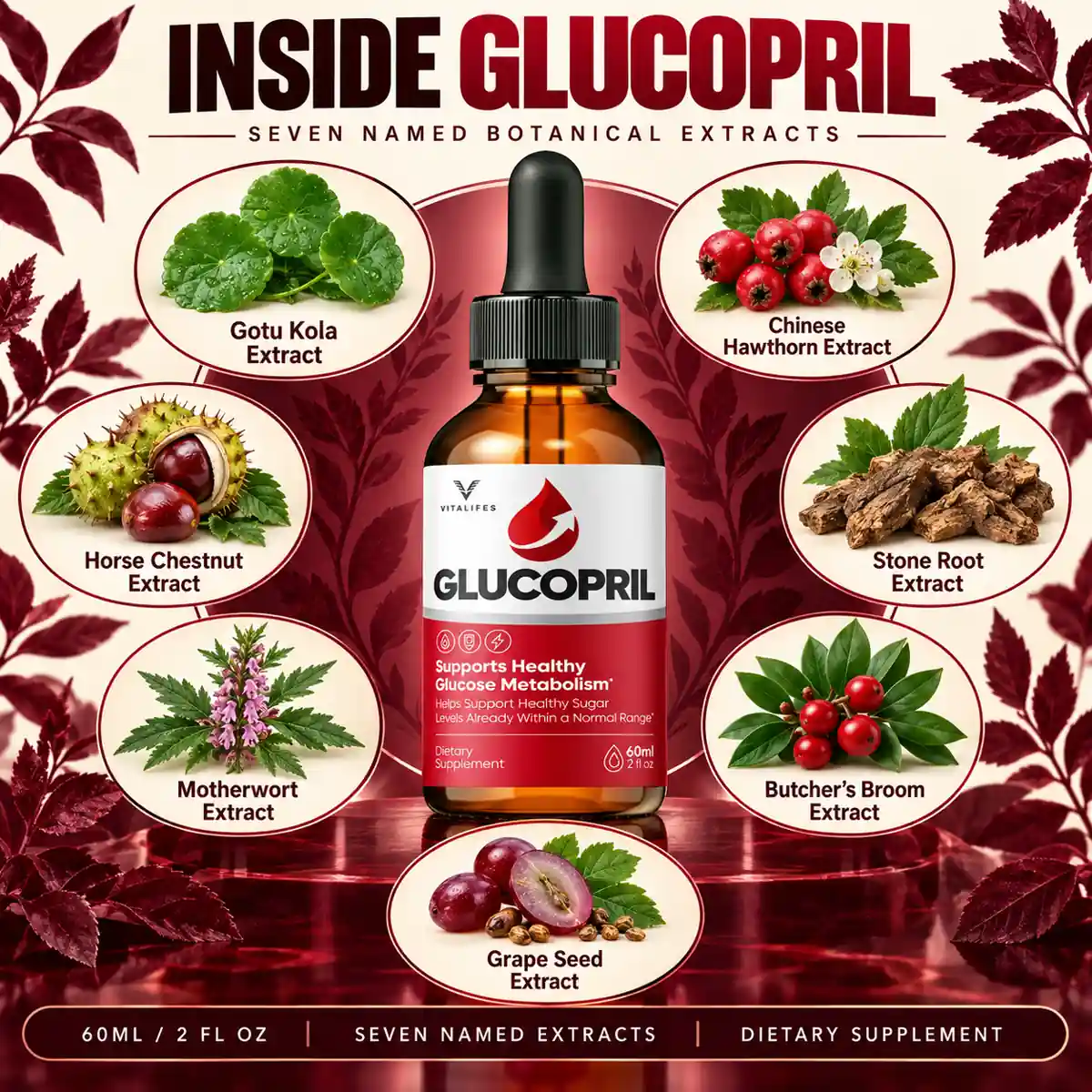
- A named ingredient list with no weights sits in the third of four disclosure tiers.
- A name tells you which literature applies. A weight tells you whether that literature is relevant to the bottle.
- The plant part being named — leaf, seed, root, fruit — is a real strength here and most of this category skips it.
- Without weights, the only numbers available are the doses the published trials used, which is why this website prints those.
- A blend total reported by a marketplace listing is not a label amount and is never treated as one here.
The four disclosure tiers
Every supplement label in this category sits in one of four places, and knowing which one you are looking at tells you how much reasoning the packaging will support.
| What a label gives you | What you can do with it | How common |
|---|---|---|
| A full panel with a weight for every active | Compare each ingredient against the dose its own trials used. Everything else follows. | A minority of this category, and the thing worth paying a premium for |
| A panel with a proprietary blend total | Know the ceiling for all ingredients together. Nothing about any one of them. | Very common |
| A named ingredient list with no weights at all | Research each plant and find out what its literature measured. No dose comparison is possible. | Common on liquids and on marketplace listings |
| A marketing panel of benefits with no ingredient list | Nothing. This is the floor. | Common on the back of a sales page rather than on a bottle |
Four tiers. This bottle sits in the third, which is better than the fourth and a long way from the first.
The jump that matters is between the first tier and the rest. A weight per active is what turns an ingredient list into something comparable, and everything a careful buyer wants to do depends on it.
The jump between the third tier and the second is smaller than it looks. A blend total gives you a ceiling and nothing else; seven named plants with no total give you a research map and nothing else. Neither lets you work out what is in a serving.
What a name on its own actually gives you
More than nothing, and it is worth being precise about how much more.
A name identifies a literature. Once you know the bottle contains horse chestnut seed extract, you can find out what horse chestnut seed extract has been tested for, at what doses, over what durations, and with what outcomes. One head-to-head comparison used 600 mg a day for four weeks and measured leg volume. That is now knowable.
A name also constrains the sales pitch. A seller who names ingredients has accepted that anybody can look them up, which is a different position from one who hides behind a blend description.
And a name allows an interaction check. Somebody on an anticoagulant can raise hawthorn specifically rather than asking about an unnamed botanical mixture, which is a far more useful conversation.
- It identifies which research applies.
- It allows an interaction to be raised by name.
- It lets a reader judge whether the ingredients match the category the product is sold in.
- It is checkable by anybody, which constrains what the seller can imply.
- It does none of the arithmetic.
What it withholds, in order of importance
First and heaviest: the amount. Without it, a trial dose is a fact about the plant rather than a fact about the bottle. The SPICE trial ran 900 mg a day of one standardised hawthorn extract for two years. Whether this bottle carries a hundredth of that or a tenth of it is not answerable from the packaging.
Second: the standardisation. “Extract” covers preparations that differ by an order of magnitude in concentration, and the venoactive trials generally used preparations standardised to a named compound group. Without a ratio or a marker percentage, the word is a category rather than a specification.
Third: how long a bottle lasts. No servings-per-container figure means cost per day cannot be worked out, which is the only comparison that survives different pack sizes.
Fourth, and easy to forget: the order of the list tells you less than it appears to. On a full panel, ingredients are ordered by weight. On a graphic with no weights, the order is whatever the designer chose.
Order GlucoPril knowing exactly what the graphic tells you
Seven named extracts with their plant parts, two drops a day after a meal, and a website that prints the dose each plant’s own trials used in place of a figure nobody published.
Price at checkout · one payment, no subscription · money-back guarantee as printed at the checkout
Order GlucoPril On The Official Website2 drops a day after a meal · 60 ml a bottle · lot GLU-26/GL-2779
Why naming the plant part matters more than it looks
This is the row where this particular label does well, and it deserves saying before anything else critical.
Nettle root and nettle leaf are different ingredients with different compounds and different trial literatures. So are grape seed and grape skin. So are hawthorn fruit and hawthorn leaf-with-flower. A label that prints only the genus has left out the first thing a reader needs in order to look anything up correctly.
This graphic names the part for all seven: leaf, fruit, seed, root and the aerial preparations. That single decision is what makes the rest of this website possible, because without it nobody could tell which body of research applied to which row.
The ten-trial meta-analysis of Ruscus preparations is a good illustration of why: it pools trials of a specific preparation of a specific part, and applying its result to a different part of the same plant would be an error nobody could detect from a bare genus name.
The workaround: trial doses instead of label doses
When a label gives no amounts, there is exactly one honest source of numbers left: what the published trials used. That is why every ingredient on this website carries a trial dose rather than a label dose.
It is a substitution with a clear limit, and the limit should be stated rather than implied. A trial dose tells you what produced an effect in a study. It does not tell you what is in a bottle, and setting the two side by side is a comparison rather than a calculation.
What it does allow is an order-of-magnitude judgement, which is usually enough to decide. When the single-plant doses in the literature run into the hundreds of milligrams and the blend total reported for a formula is about 121 mg for seven plants together, the arithmetic is not close and does not need precision to be informative.
- Write down each ingredient and its plant part.
- Find the pooled or largest trial for each and note the dose and the duration.
- Note the primary outcome that trial measured.
- Set those doses against whatever total the product does disclose, if any.
- Judge the product on the pattern rather than on any single row.
The row where even the workaround runs out
Stone root is the fourth name on this graphic and it is the one place where the method above produces nothing at all.
A PubMed search for Collinsonia canadensis returns a single indexed record, and it is a high-throughput laboratory screen of natural products against a cell line. There is no human trial of stone root for veins, for blood sugar, or for anything else.
That is worth printing rather than glossing. An ingredient with no clinical literature behind it cannot be evaluated by any method available to a reader, and a website that quietly left it out of the comparison would be presenting a better picture than the evidence supports.
The ingredients page prints that row with the same prominence as the other six.
Six questions to ask any label
These take about two minutes with a photograph of the packaging, and they produce a comparable answer across every product in a browser window.
| Question | Answer for this bottle | What the answer is worth |
|---|---|---|
| Is an amount given for each active? | No | It means no trial dose in the literature can be compared to what is inside |
| Is a blend total given? | Marketplace listings report about 121 mg. The bottle itself gives none. | A ceiling for seven plants together, from a source that is not the label |
| Is the plant part named? | Yes, for all seven | Genuinely useful, and better than most of this category manages |
| Is the extract ratio or standardisation given? | No | It means “extract” covers a range from concentrated to barely so |
| Is a servings-per-container figure given? | No | Cost per day cannot be calculated from the packaging |
| Is the daily dose given? | Yes: two drops after a meal | The one dosing instruction the label is firm about |
Six questions, six honest answers, and the pattern they make is what this article is about.
Three yes and three no is a middling score and an honest one. The seven-check scorecard is the longer version of the same exercise, and it applies all seven checks to this bottle with four failures printed in the open.
What to actually do with the answers
If a label reaches the first tier, use it: compare every ingredient against its trial dose and you have a genuinely informed decision.
If it reaches the third tier, as this one does, the decision is different in kind. You are choosing on the identity of the ingredients, on whether their literature matches what the product is sold for, and on whether the seller is answerable when something goes wrong. Those are real criteria; they are just not dose criteria.
NCCIH's guidance on using supplements wisely and MedlinePlus's overview of the category both come down in the same place: know what is in it, know what the evidence is, and know who to ask. Two of those three are answerable from a label with no amounts on it, which is more than nothing and less than a buyer deserves.
A trial dose is per plant, per day. A blend total is for everything together. Those two numbers being set beside each other is the single most useful habit a reader of this category can develop, and it works on every bottle on the shelf.
References
- Koch R. Comparative study of Venostasin and Pycnogenol in chronic venous insufficiency. Phytother Res. 2002;16 Suppl 1:S1-5. PMID 11933130. https://pubmed.ncbi.nlm.nih.gov/11933130/
- Holubarsch CJ, Colucci WS, Meinertz T, et al. The efficacy and safety of Crataegus extract WS 1442 in patients with heart failure: the SPICE trial. Eur J Heart Fail. 2008;10(12):1255-63. PMID 19019730. https://pubmed.ncbi.nlm.nih.gov/19019730/
- Kakkos SK, Allaert FA. Efficacy of Ruscus extract, HMC and vitamin C, constituents of Cyclo 3 fort, on improving individual venous symptoms and edema: a systematic review and meta-analysis of randomized double-blind placebo-controlled trials. Int Angiol. 2017;36(2):93-106. PMID 28225220. https://pubmed.ncbi.nlm.nih.gov/28225220/
- Mazzio E, Badisa R, Mack N, et al. High throughput screening of natural products for anti-mitotic effects in MDA-MB-231 human breast carcinoma cells. Phytother Res. 2014;28(6):856-67. PMID 24105850. https://pubmed.ncbi.nlm.nih.gov/24105850/
- Using Dietary Supplements Wisely. National Center for Complementary and Integrative Health, National Institutes of Health. https://www.nccih.nih.gov/health/using-dietary-supplements-wisely
- Dietary Supplements. MedlinePlus, U.S. National Library of Medicine. https://medlineplus.gov/dietarysupplements.html