GlucoPril Official Website › Blog › Butcher's Broom
Butcher’s Broom And Diabetes: A Review, Two Animal Studies And A Case Report
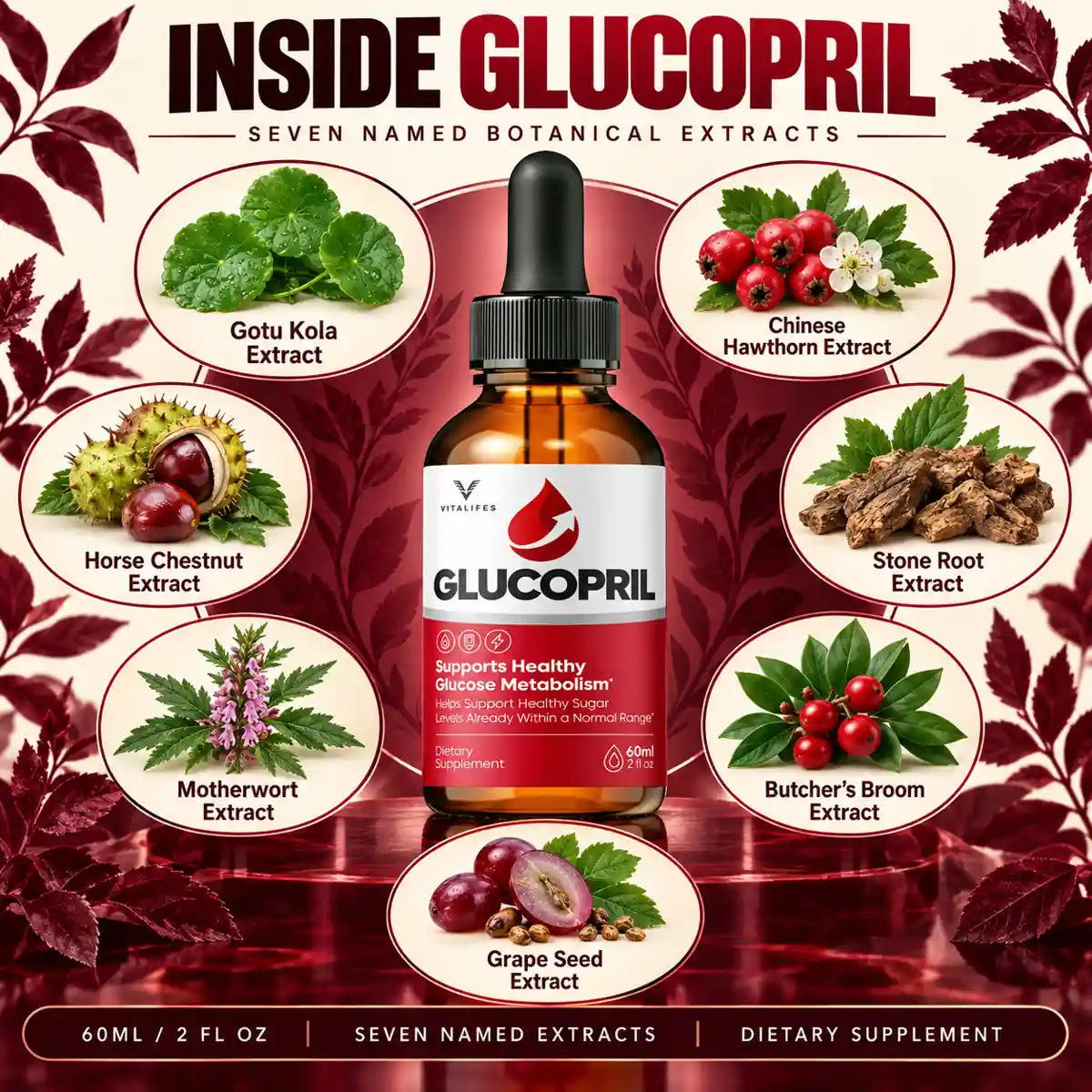
Butcher’s broom is the sixth extract on this bottle’s graphic, and a search for it alongside the word diabetes turns up a short, odd list of records. There is one Cochrane review, two studies in diabetic animals, and one case report of a woman who developed diabetic ketoacidosis a few days after starting it. Nothing on the list is a glucose trial in people. Here is each record, read carefully, and what they add up to.
- A 2018 Cochrane review of single herbal medicines for diabetic retinopathy covered ten trials and 754 people. A Ruscus extract tablet was one of six herbal interventions. No trial reported the review’s primary outcome, and the authors concluded that no conclusions could be drawn about any single herb.
- A 1997 study gave a Ruscus-based oral product to hamsters with streptozotocin-induced diabetes for four weeks. Leaks from capillaries fell by about half at 10 mg/kg a day, and blood glucose did not differ between the groups. A 2014 rat study of isolated ruscogenin found the same pattern in the kidney: better renal measures, no fall in glucose or HbA1c.
- A 2013 case report describes a 39-year-old woman who developed diabetic ketoacidosis five days after starting butcher’s broom for mild ankle swelling. One case cannot prove a cause, and its authors point to the plant’s alpha-adrenergic properties as the reason for concern.
- The plant’s substantial trial literature is about chronic venous insufficiency, and it is usually run on Ruscus combined with hesperidin methylchalcone and vitamin C, which this bottle does not name.
- No study in the indexed literature tests butcher’s broom against a blood glucose or HbA1c outcome in people.
What it is, and the thread it is known for
Butcher’s broom is Ruscus aculeatus, a low, spiny evergreen shrub from the Mediterranean and western Europe. The parts used medicinally are the rhizome and root, the thick underground stem, and the compounds usually credited are steroidal saponins such as ruscogenin and neoruscogenin. The plant is a European pharmacy staple for heavy, tired, swollen legs, and that is where nearly all of its clinical research sits.
A 2016 review in the International Angiology journal describes a Ruscus extract, on its own and combined with hesperidin methyl chalcone and ascorbic acid, as having been used in chronic venous disease in some European countries for more than fifty years, with effects on veins, on the microcirculation and on lymphatics. That last phrase is the one to hold onto: microcirculation. It is the reason a plant from the vein shelf ever gets discussed near a diabetes complication, because diabetes damages the smallest vessels in the body, in the eye, the kidney and the nerves, and a plant reputed to act on small-vessel leakage is at least on the right street.
The most recent review, published in Molecules in November 2025, is candid about the state of things. It says the available data support the plant’s traditional use, but that studies of Ruscus remain limited, that many have been done on complex formulations such as Cyclo 3 Fort, which also contains hesperidin methylchalcone and ascorbic acid, and that this makes it difficult to attribute the observed effects to the plant alone. Keep that sentence in mind. It applies to nearly everything below.
For scale, the venous literature at its most typical looks like a 2007 open, multicentre study of 124 people with chronic venous insufficiency, given two capsules a day of Ruscus aculeatus 150 mg, hesperidin methylchalcone 150 mg and ascorbic acid 100 mg for eight weeks. Reports of pain, heaviness, cramps and oedema, which had been intense in 74 to 85 per cent of the group at the start, fell steeply within two weeks, and skin capillary microscopy showed changes that tracked the symptoms. It was open-label, with no placebo arm, and it says nothing about glucose. It is here only to show what the plant’s real research looks like.
The Cochrane review, read closely
The record that puts butcher’s broom in the same sentence as diabetes is a 2018 Cochrane review titled “Single herbal medicine for diabetic retinopathy”. Diabetic retinopathy is damage to the small blood vessels of the retina from long-standing high glucose, and it is one of the major causes of blindness. The review set out to assess the benefit and harm of any single herb, or extract from a single herb, for people who already have it.
The authors searched the Cochrane Central register, MEDLINE, Embase, trial registries and several Chinese databases, with the main search dated June 2018, and included randomised and quasi-randomised trials. They found ten studies with 754 participants, nine from China and one from Poland. In every study both groups received conventional treatment for the eye disease, including medicines for glucose and lipids and a stable diabetic diet, and in three studies the comparison group also got a potentially active vasoprotective drug. The herbs and extracts across the ten trials were a Ruscus extract tablet, Sanqi Tongshu capsule, tetramethylpyrazine injection, Xueshuantong injection, puerarin injection and Xuesaitong injection. The Ruscus extract is the only one of the six that also appears on this bottle’s graphic.
| What the review looked at | What it found |
|---|---|
| Progression of retinopathy (the primary outcome) | Reported by none of the ten studies |
| Gaining two or more lines of visual acuity | More likely with the herbs than without in a combined analysis of five trials and 541 people (risk ratio 1.26, 95% CI 1.08 to 1.48), rated low-certainty. This is a pooled result across the different herbs, not a Ruscus result |
| Microaneurysms and retinal haemorrhages | One trial of the Sanqi Tongshu capsule suggested a greater reduction, rated very low-certainty |
| HbA1c | Little effect in a pooled analysis of two trials of tetramethylpyrazine or Xueshuantong injection (mean difference 0.00, 95% CI −0.58 to 0.58) |
| Adverse events | Two studies reported minor events such as stomach upset, hives, dizziness and headache. Very low-certainty evidence |
| Risk of bias | High in all ten studies, mainly because participants were not masked |
Every row is read from the review’s abstract. Subgroup analyses by herb found no evidence that different herbs behaved differently, though the review notes that the power to detect a difference was low.
The review’s own conclusion is worth quoting exactly: “No conclusions could be drawn about the effect of any single herb or herbal extract on diabetic retinopathy from the current available evidence.” It adds that it was difficult to exclude a placebo effect, because none of the included studies used a placebo.
Order GlucoPril with the Cochrane verdict in front of you
Seven named botanical extracts, two drops a day after a meal, and a website that prints what the strongest available review actually concluded rather than what a front panel implies.
Price at checkout · one payment, no subscription · money-back guarantee as printed at the checkout
Order GlucoPril On The Official Website2 drops a day after a meal · 60 ml a bottle · lot GLU-26/GL-2779
What “no conclusions could be drawn” does and does not mean
Reviews like this get misread in two opposite directions, so it is worth being careful about what the sentence says.
It does not say the herbs were shown not to work. That would take well-run trials with clear negative results, and these were not that. Equally it does not say the herbs work but need more study to prove it. The ten trials were, in the review’s own grading, mostly at high risk of bias, unmasked, and without placebo controls, and the visual acuity signal, the one mildly encouraging result, comes from five trials pooled across different herbs with low certainty. It cannot be attributed to the Ruscus tablet specifically, and the abstract does not try to.
A sales page could truthfully write “studied for diabetic eye health” on the basis of one trial being swept into this review, and the review that swept it in would decline to draw any conclusion from it. That gap between what can be said and what the evidence supports is the subject of the article on a glucose name on a circulation formula, and it is why this site prefers to print the review’s own sentence rather than a paraphrase.
Note also what the review was for. Its patients already had retinopathy and were on standard treatment. Nothing in it concerns someone whose sugar levels are already within a normal range, which is the population the front of this bottle is written about. And a note the site would be failing in its job to omit: diabetic eye disease is diagnosed and followed by an eye-care professional, and anyone with diabetes should keep their scheduled eye examinations whatever supplement they use.
Two diabetic animal studies, and a glucose reading that did not move
The second record is small and old, and it is the one that most closely resembles the mechanism people have in mind. A 1997 study in Clinical Hemorheology and Microcirculation induced moderate diabetes in hamsters with two injections of streptozotocin, then gave them placebo or oral Cyclo 3 Fort, whose active principle the abstract identifies as Ruscus aculeatus extract, at 2, 10 or 50 mg/kg a day for four weeks. The researchers then watched the cheek pouch under a microscope, using a fluorescent dextran to spot plasma escaping through leaky capillary walls after histamine was applied.
The count of leaks per square centimetre was 258 in the placebo group, 253 at 2 mg/kg, 125 at 10 mg/kg and 99 at 50 mg/kg, with the two higher doses significantly lower than placebo. Blood glucose was measured and did not differ between the groups. The authors’ summary is that the oral product inhibited histamine-induced plasma exudation in hamsters with mild diabetes without affecting the glycaemia.
Two things stand out. The first is that this is the outcome you would design a test for if you believed the plant acted on small vessels, and it is a real effect on that outcome in an animal model of diabetes. The second, and it is the point the rest of this site keeps returning to, is that the effect happened without changing glucose. That is exactly the shape of a vein-shelf ingredient: something that acts on the vessel wall, not on sugar. It is an animal study on cheek-pouch leaks, and it should not be inflated into a claim about people, but it is the nearest thing in the record to a mechanism, and it matches the way every other ingredient on this label behaves.
A second animal record points the same way from a different organ. A 2014 study in rats with streptozotocin-induced diabetes gave ruscogenin, the steroid sapogenin usually credited for butcher’s broom’s activity, by mouth at 0.3, 1.0 or 3.0 mg/kg for eight weeks. It is an isolated compound rather than the whole extract, and the paper describes it as a major sapogenin of a different plant, Ophiopogon japonicus, so it is a supporting note rather than a study of this ingredient. Its result was that ruscogenin did not lower plasma glucose or glycosylated haemoglobin in the diabetic rats, but reversed a set of kidney abnormalities, including reduced creatinine clearance and protein in the urine, and quietened an inflammatory pathway in the kidney. Same lesson, different organ: an effect on the tissue, none on the sugar.
One case report, and why the mechanism matters
The third record is one a reader deserves to know about, because it is the only one that touches safety in a person with diabetes. A 2013 case report in the Journal of Emergency Medicine describes a 39-year-old woman who developed diabetic ketoacidosis five days after beginning butcher’s broom for mild ankle swelling. Her illness was complicated by high potassium and severe acidosis, with a blood pH of 7.02. She was treated with intravenous fluids, insulin and calcium gluconate, stabilised, and discharged several days later.
The authors’ background note is that butcher’s broom contains substances with alpha-adrenergic-stimulating properties, and they present the case as a small but potentially serious public health concern in a diabetic woman taking it. An older review, published in the Journal of Alternative and Complementary Medicine in 2000, is where that pharmacology is spelled out. It proposes Ruscus as a possible treatment for orthostatic hypotension, and describes the plant as an alpha-adrenergic agonist that constricts veins by directly activating alpha-1 and alpha-2 receptors on the vessel wall and prompting release of noradrenaline. That review is a proposal and a single case report, not a trial, and it is quoted here only for the mechanism it describes.
Read this fairly. A single case report cannot show that the plant caused the ketoacidosis. Diabetic ketoacidosis has many triggers, and the abstract gives no doses, no product details and no exclusion of other causes. It is not evidence of a rate, and this website does not treat it as one. What it is, is a signal: a plausible mechanism, one documented event, and a population, people with diabetes, in whom an acute metabolic emergency matters far more than an ordinary side effect. That is enough to make it a question to raise with a prescriber before anyone with diabetes, or anyone taking a blood pressure medicine, adds butcher’s broom. It is also a reminder that the side effects page, which summarises what the trials recorded, sits alongside a case literature that a trial summary will not capture.
Setting the studied doses beside this bottle
The seller names butcher’s broom extract as one of seven and prints no amount for any of them, and marketplace reports describe a combined blend of about 121 mg. Nobody outside the factory can say what share of that is butcher’s broom, which is the problem the article on labels with no amounts is about.
| What the record used | Amount | What this bottle prints |
|---|---|---|
| Venous insufficiency study, 2007 (open, 124 people) | Two capsules a day, each described as Ruscus 150 mg, hesperidin methylchalcone 150 mg, ascorbic acid 100 mg, for 8 weeks | No amount for Ruscus; neither companion ingredient is on the graphic |
| Hamster capillary-leak study, 1997 | 2, 10 and 50 mg/kg a day for 4 weeks; effect from 10 mg/kg | Cannot be converted into a human dose from a printed figure that does not exist |
| Cochrane review, 2018 | The abstract gives no dose for the Ruscus tablet | Not applicable |
| Case report, 2013 | Not stated in the abstract | Not applicable |
If each 2007 capsule carried the amounts the abstract lists, the venous study ran on about 300 mg of Ruscus a day. That is more than double the reported total for all seven plants on this bottle put together.
The comparison is uncomfortable in the way most comparisons on this label are. A study dose that is a multiple of the whole seven-plant blend cannot be quietly extended to a share of two drops. The reverse is fair to say too: a small amount of anything is also a small amount of whatever caution attaches to it. Nobody knows the dose in the bottle, and so nobody can say in either direction how any of these records applies to it.
What the record adds up to
Put the three records side by side and the picture is consistent, if unglamorous.
On glucose, there is nothing. No trial in the indexed literature measures butcher’s broom against fasting glucose or HbA1c in people, and the two animal studies that measured glucose found it unchanged.
On diabetes complications, the honest word is open. The strongest review to touch it covered a Ruscus tablet among six herbs and concluded that no conclusion could be drawn for any of them.
On safety in people with diabetes, there is a plausible mechanism and one serious case report, and a reader with diabetes has a reason to speak to a clinician first rather than a reason to panic.
None of this is a case against the plant. It has a real, respectable record in the leg-vein work that made its name, and the ingredients page sets each of the seven beside the dose its own research used. It is a case for reading a label that says supports healthy glucose metabolism with the understanding that, for this plant, the glucose part has no research under it, and the research that exists is about something else.
Three questions before reading “studied for diabetes” as a claim
- Was the primary outcome reported? In the Cochrane review, retinopathy progression was reported by none of the ten trials.
- Was there a placebo control? None of the ten had one, which is exactly why a placebo effect could not be excluded.
- Which herb did the result belong to? The one mildly positive number, visual acuity, was pooled across all the herbs. It cannot be handed to any single one of them.
A dietary supplement for healthy adults of 18 and over, not a medicine and not FDA-approved. The label’s claim is limited to supporting healthy glucose metabolism and sugar levels already within a normal range; it does not extend to any complication of diabetes. Anyone with diabetes, or taking a glucose-lowering or blood pressure medicine, should raise butcher’s broom with their prescriber before starting.
References
- Zhang HW, Zhang H, Grant SJ, Wan X, Li G. Single herbal medicine for diabetic retinopathy. Cochrane Database Syst Rev. 2018;12(12):CD007939. PMID 30566763. https://pubmed.ncbi.nlm.nih.gov/30566763/
- Svensjö E, Bouskela E, Cyrino FZ, Bougaret S. Antipermeability effects of Cyclo 3 Fort in hamsters with moderate diabetes. Clin Hemorheol Microcirc. 1997;17(5):385-8. PMID 9502536. https://pubmed.ncbi.nlm.nih.gov/9502536/
- Lu HJ, Tzeng TF, Liou SS, Da Lin S, Wu MC, Liu IM. Ruscogenin ameliorates diabetic nephropathy by its anti-inflammatory and anti-fibrotic effects in streptozotocin-induced diabetic rat. BMC Complement Altern Med. 2014;14:110. PMID 24666993. https://pubmed.ncbi.nlm.nih.gov/24666993/
- Sadarmin PP, Timperley J. An unusual case of Butcher's Broom precipitating diabetic ketoacidosis. J Emerg Med. 2013;45(3):e63-5. PMID 23849361. https://pubmed.ncbi.nlm.nih.gov/23849361/
- Redman DA. Ruscus aculeatus (butcher's broom) as a potential treatment for orthostatic hypotension, with a case report. J Altern Complement Med. 2000;6(6):539-49. PMID 11152059. https://pubmed.ncbi.nlm.nih.gov/11152059/
- Pacuła W, Sowa I, Feldo M, Graczyk F, Patryn R, Wójciak M. Current Insights into the Phytochemistry and Pharmacological Properties of Ruscus aculeatus. Molecules. 2025;30(22). PMID 41302473. https://pubmed.ncbi.nlm.nih.gov/41302473/
- Allaert FA. Combination of Ruscus aculeatus extract, hesperidin methyl chalcone and ascorbic acid: a comprehensive review of their pharmacological and clinical effects and of the pathophysiology of chronic venous disease. Int Angiol. 2016;35(2):111-6. PMID 26928296. https://pubmed.ncbi.nlm.nih.gov/26928296/
- Aguilar Peralta GR, Arévalo Gardoqui J, Llamas Macías FJ, Navarro Ceja VH, Mendoza Cisneros SA, Martínez Macías CG. Clinical and capillaroscopic evaluation in the treatment of chronic venous insufficiency with Ruscus aculeatus, hesperidin methylchalcone and ascorbic acid in venous insufficiency treatment of ambulatory patients. Int Angiol. 2007;26(4):378-84. PMID 18091707. https://pubmed.ncbi.nlm.nih.gov/18091707/