GlucoPril Official Website › Blog › Gotu Kola
Gotu Kola: What Its Trials Actually Measured
Centella asiatica leads the ingredient graphic on this bottle, and it has a better clinical record than most botanicals on a supplement shelf. The record is just not about blood sugar. Four trials, four doses, and what each one put a number on.
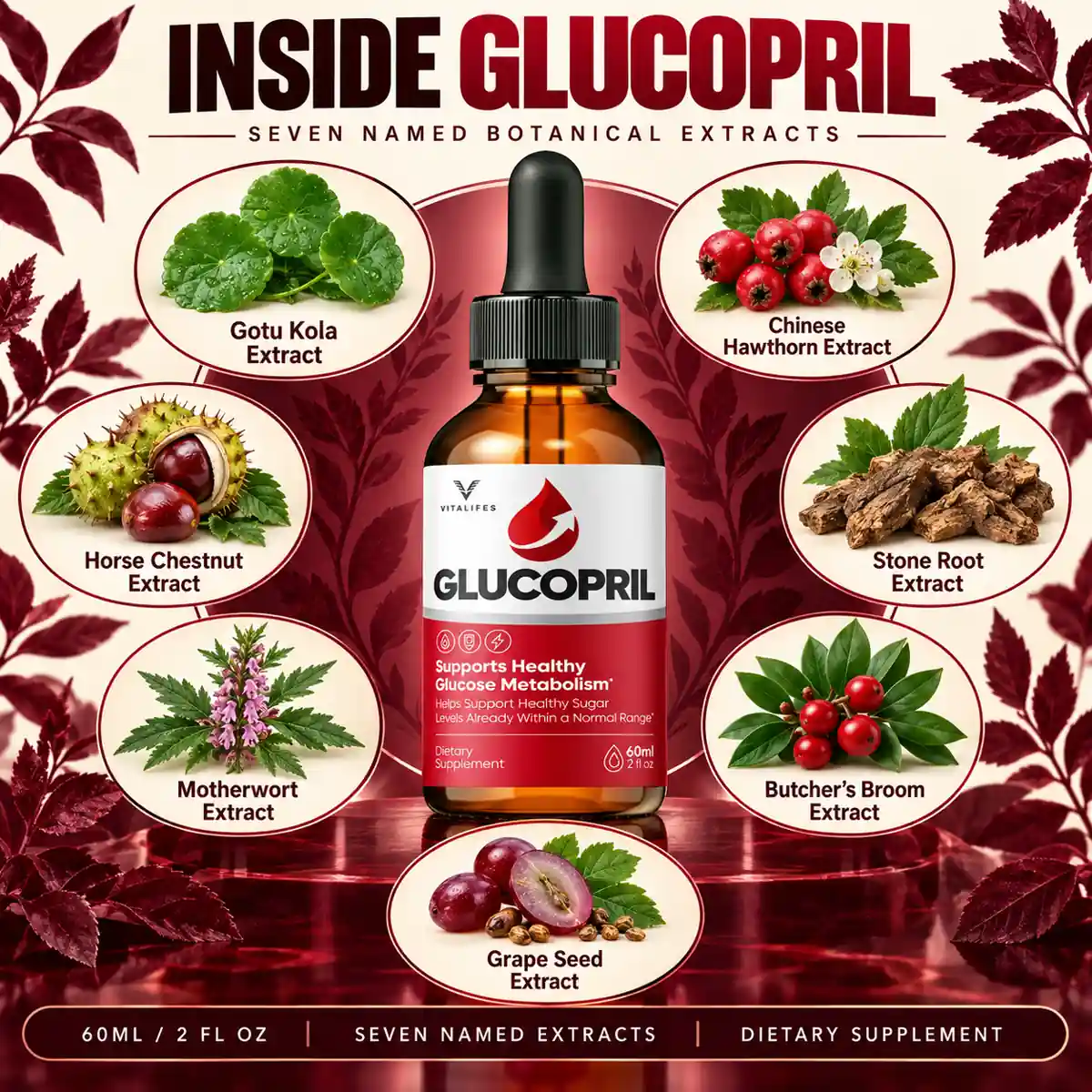
- Gotu kola is the first of seven extracts named on this bottle’s ingredient graphic.
- Its best-known trials used a standardised triterpene fraction at 90–180 mg a day for four weeks, and 120 mg a day for six months in people with diabetes.
- What those trials measured was ankle swelling, capillary filtration and skin microcirculation in the lower leg.
- The one trial run in people with diabetes studied microangiopathy, a complication of the condition, rather than a glucose reading.
- There are two indexed case reports of liver injury after Centella, at intakes far above anything a seven-plant blend would carry.
What gotu kola is, and which part is used
Centella asiatica is a low, creeping plant of wet ground across South and Southeast Asia, eaten as a vegetable in several cuisines and used in traditional medicine for far longer than anyone has been running trials on it. The part that reaches a supplement is the leaf and the aerial growth above it.
That part is named on this bottle’s ingredient graphic, which is worth crediting. A great deal of this category prints a plant name and stops. Here the graphic says leaf, and for gotu kola the leaf is the correct answer: it is what the clinical literature used.
Where its reputation comes from
European vascular medicine has taken Centella seriously for decades, and that is the literature underneath every claim you will read about it. It belongs to the venoactive group, the preparations a clinic reaches for when the complaint is heavy, swollen legs at the end of the day rather than a number on a meter.
The fraction the trials ran on
This is the detail that separates a useful reading of the research from a careless one. The trials below did not use gotu kola leaf. They used the total triterpenic fraction of Centella asiatica, a standardised preparation defined by how much of a specific compound group it contains.
A standardised fraction and a whole-leaf extract are related in the way orange juice and an orange are related. One is derived from the other and neither substitutes for it in a measurement. When a trial reports 180 mg a day, that figure describes the fraction, and applying it to a different preparation is an assumption rather than a calculation.
| What the label names | What the trials used | Why the difference matters |
|---|---|---|
| Gotu Kola Extract (Centella asiatica, leaf) | Total triterpenic fraction of Centella asiatica, a standardised preparation | A whole-leaf extract and a triterpene-standardised fraction are not interchangeable; the second is defined by how much of a named compound group it contains |
| First of seven extracts, no amount beside it | 90–180 mg a day of that fraction alone | A blend total of about 121 mg, reported by marketplace listings rather than printed on the bottle, is the ceiling for all seven plants together |
| Two drops of a liquid, after a meal | Capsules or tablets, two or three times a day, for four weeks to six months | Same oral route, different form and a different schedule |
The left column is read off the seller's own ingredient graphic. The middle column is what the published studies used, not a prediction about this bottle.
The third row of that table is the honest summary. Same plant, same part, same broad route into the body, and three differences — the preparation, the schedule and the amount — that between them decide whether a trial result has anything to say about a bottle.
Four trials and four doses
Here is what the published work on this fraction actually ran, in the form a reader can check. Every row links to its record in the reference list at the foot of this page.
| Trial | Dose used | How long | What it measured |
|---|---|---|---|
| The dose-ranging trial in venous hypertension | 30 mg or 60 mg three times a day, so 90 or 180 mg a day | 4 weeks | Ankle oedema and capillary filtration rate |
| The venous hypertensive microangiopathy trial | The same standardised triterpene fraction | Reported alongside the above | Microcirculatory measures in the skin of the lower leg |
| The diabetic microangiopathy trial | 60 mg twice a day, so 120 mg a day | 6 months | Microcirculation in people with diabetes, using a microcirculatory model |
| The long-haul flight trial | The same fraction, given around flights | Short course | Ankle and foot swelling after extended air travel |
Every dose in the second column is a single-plant dose of a standardised extract, taken by mouth, in a capsule or tablet.
The most instructive row is the first. The dose-ranging trial gave 30 mg or 60 mg three times a day for four weeks in venous hypertension, and it concluded that the higher of the two arms — 180 mg a day — was the more effective. A trial that deliberately compares two doses and finds the larger one better is telling you that the amount matters, which is exactly the information a panel with no weights on it withholds.
The microangiopathy trial sits alongside it in the same journal supplement and reports on microcirculatory measures in the skin of the lower leg. The long-haul flight trial is the most everyday of the four: ankle and foot swelling after extended air travel, in people with no particular condition.
- Every dose is a single-plant dose. None of these trials was testing a seven-plant blend.
- Every outcome is a measurement of a leg, a skin capillary or a fluid shift.
- Every course ran for four weeks at minimum, and one ran for six months.
- Every preparation was a standardised fraction rather than a general leaf extract.
- None of them measured fasting glucose or HbA1c.
The one trial run in people with diabetes
A six-month randomised trial gave 60 mg twice a day — 120 mg a day — to people with diabetes and evaluated the treatment of diabetic microangiopathy using a microcirculatory model. It is the closest thing in the entire gotu kola literature to a trial relevant to a glucose product, and it is worth being precise about what it shows.
Diabetic microangiopathy is damage to the smallest blood vessels, a complication that follows from years of raised glucose rather than a measure of glucose itself. Improving a microcirculatory measure in somebody who has that complication is a real and useful finding. It is not a finding about blood sugar.
The distinction is the whole reason this article exists. A marketing page can write “studied in people with diabetes” and be entirely accurate while leaving a reader with a conclusion the trial does not support.
Setting those doses beside this bottle
Marketplace reports describe the actives in this formula grouped in a proprietary blend of about 121 mg. That figure comes from those reports rather than from the bottle, and it is the total for all seven plants together.
Set 121 mg for seven against 90–180 mg a day for one and the arithmetic is straightforward. Even if gotu kola took the largest share of the blend, a per-day intake in the range the trials used is not reachable from that total.
This is not an accusation of dishonesty. The bottle claims nothing about gotu kola doses. It is an argument about what a reader can conclude.
The seller names seven extracts and gives a weight for none of them. A figure nobody published cannot be invented, so every ingredient on this site carries the dose its own research used instead. It is the only number on the subject anybody can check.
Order GlucoPril with the gotu kola arithmetic in front of you
Seven named botanical extracts, two drops a day after a meal, and a website that prints what each plant’s trials measured rather than what a front panel implies.
Price at checkout · one payment, no subscription · money-back guarantee as printed at the checkout
Order GlucoPril On The Official Website2 drops a day after a meal · 60 ml a bottle · lot GLU-26/GL-2779
What a pharmacokinetic study adds
A phase 1 pharmacokinetic study of a standardised Centella product is worth a paragraph because it answers a question most ingredient articles skip: does the compound get into the bloodstream at all, and at what concentration?
Pharmacokinetics is the unglamorous half of botanical research and the half that decides whether anything else matters. A compound that does not absorb cannot act, however elegant the laboratory mechanism looks, and a plant with a pharmacokinetic study behind it has cleared a bar that many ingredients in this category have never been held to.
What it does not do is close the gap in the section above. Knowing that a compound absorbs at a given dose makes the dose more important, not less.
The two liver case reports
Two indexed case reports describe liver injury following Centella asiatica: one in an adult and one in a child. Both are worth knowing about and neither is a reason for alarm at the amounts in question here.
A case report is the weakest form of clinical evidence: a single patient, described after the fact, with no control and no way to exclude other causes. It is a signal that something is worth watching rather than a finding that something causes harm.
Both reports involve far more Centella than two drops of a seven-plant blend would carry, and they belong here because an ingredient page printing only the encouraging half of a literature is not worth reading.
“Dietary supplement. For adults. Follow the directions printed on the bottle and keep it out of reach of children.” That is the full extent of the printed caution, and it is the same sentence this category prints everywhere.
What gotu kola is not being accused of
Nothing in this article says gotu kola does not work. It has a clinical literature that many supplement ingredients would envy: randomised, placebo-controlled, dose-ranging, across several indications and one of them six months long.
The argument is narrower and it is about arithmetic. A trial dose is per plant, per day. A blend total reported at about 121 mg is for seven plants together. Those two numbers can be set beside each other by anybody.
- The plant is real, the trials are real, and the outcomes they measured were legs and capillaries rather than glucose.
- The preparation in those trials was a standardised fraction, not a general leaf extract.
- The doses ran from 90 to 180 mg a day of that fraction alone.
- The blend total reported for this formula is about 121 mg for all seven plants.
- Nothing in that sequence requires anyone to have behaved badly.
Four questions worth asking of any gotu kola row
Carry these to any label in this category, not just this one. They take about a minute each and they separate an ingredient list you can evaluate from one you cannot.
- Which part? Leaf and aerial parts are the studied material. A label that does not say has left out the first thing you need.
- Which preparation? A standardised triterpene fraction is what the trials used. “Extract” on its own covers a very wide range.
- How much? Per serving, per day, for that plant alone. A blend total will not answer it.
- Measured against what? If the trial you are being sold on measured ankle circumference, the product should be sold on ankle circumference.
This bottle answers the first question clearly, leaves the second open, does not answer the third at all, and is sold on something other than what its lead ingredient was tested for. Two out of four, stated plainly, is more than most labels on the shelf will let you work out. The ingredients page runs the same exercise across all seven plants.
References
- De Sanctis MT, Belcaro G, Incandela L, et al. Treatment of edema and increased capillary filtration in venous hypertension with total triterpenic fraction of Centella asiatica: a clinical, prospective, placebo-controlled, randomized, dose-ranging trial. Angiology. 2001;52 Suppl 2:S55-9. PMID 11666125. https://pubmed.ncbi.nlm.nih.gov/11666125/
- Cesarone MR, Belcaro G, De Sanctis MT, et al. Effects of the total triterpenic fraction of Centella asiatica in venous hypertensive microangiopathy: a prospective, placebo-controlled, randomized trial. Angiology. 2001;52 Suppl 2:S15-18. PMID 11666117. https://pubmed.ncbi.nlm.nih.gov/11666117/
- Cesarone MR, Incandela L, De Sanctis MT, et al. Evaluation of treatment of diabetic microangiopathy with total triterpenic fraction of Centella asiatica: a clinical prospective randomized trial with a microcirculatory model. Angiology. 2001;52 Suppl 2:S49-54. PMID 11666124. https://pubmed.ncbi.nlm.nih.gov/11666124/
- Cesarone MR, Incandela L, De Sanctis MT, et al. Flight microangiopathy in medium- to long-distance flights: prevention of edema and microcirculation alterations with total triterpenic fraction of Centella asiatica. Angiology. 2001;52 Suppl 2:S33-7. PMID 11666121. https://pubmed.ncbi.nlm.nih.gov/11666121/
- Wright KM, Bollen M, David J, et al. Pharmacokinetics and pharmacodynamics of key components of a standardized Centella asiatica product in cognitively impaired older adults: a phase 1, double-blind, randomized clinical trial. Antioxidants (Basel). 2022;11(2). PMID 35204098. https://pubmed.ncbi.nlm.nih.gov/35204098/
- Jorge OA, Jorge AD. Hepatotoxicity associated with the ingestion of Centella asiatica. Rev Esp Enferm Dig. 2005;97(2):115-24. PMID 15801887. https://pubmed.ncbi.nlm.nih.gov/15801887/