GlucoPril Official Website › Blog › Motherwort
Motherwort's Caution Line, And What The Research Actually Says
Motherwort is the fifth extract on this bottle’s ingredient graphic, and herbal references have long carried a caution against it in pregnancy. That caution comes from centuries of traditional use, not from a modern clinical trial — because a search of the published literature finds almost no modern trial of this plant on any outcome at all.
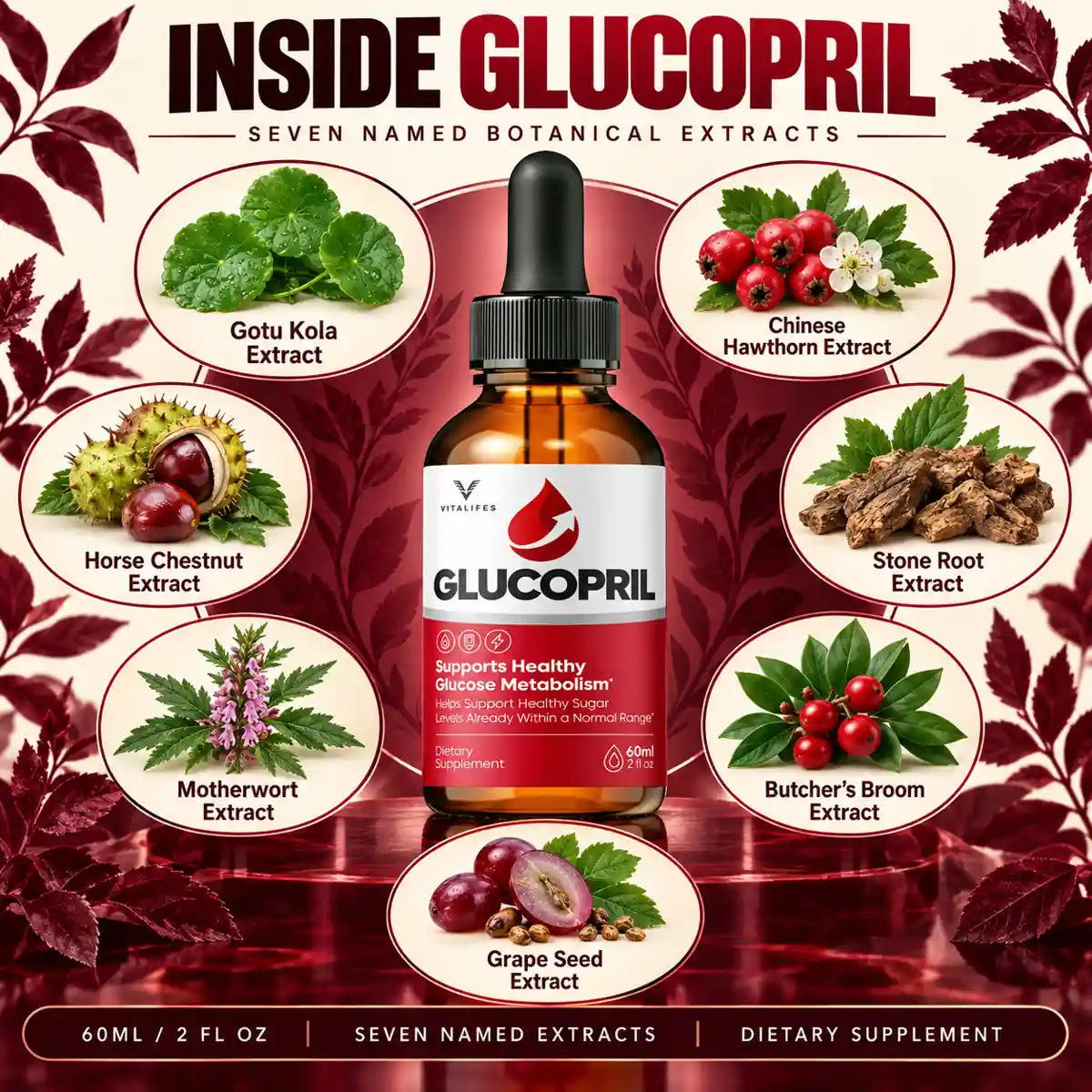
- Motherwort (Leonurus cardiaca) has a centuries-old traditional caution against use in pregnancy, rooted in its reputed uterine-stimulant action.
- A PubMed search on the plant returns only a handful of records, and none of them is a controlled human trial of any kind.
- One isolated-compound study in an animal inflammation model is the closest the literature comes to touching the traditional claim directly.
- No trial of motherwort against any glycaemic outcome exists, so it has nothing to add to this bottle's blood-sugar claim either.
- This bottle's own printed caution — not for pregnancy or nursing — is the right instruction regardless of how thin the modern evidence is.
What motherwort is, and where the caution comes from
Leonurus cardiaca, motherwort, is a member of the mint family long used in European herbal medicine for heart palpitations, anxiety and menstrual and postpartum complaints — the name itself reflects centuries of use around childbirth. That same traditional reputation is exactly why herbal references caution against motherwort in pregnancy: a plant used traditionally to encourage labour and support the postpartum uterus is not a plant traditional practice recommends taking beforehand.
This is a caution built entirely on traditional use and case-level herbal knowledge passed down through practice, not on a randomised trial that tested the claim directly. That does not make the caution wrong — traditional-use cautions have a long track record of anticipating risks that formal research later confirms — but it does mean the caution and the modern clinical evidence are two different things, and this article is about the second one.
How motherwort ended up on a glucose-framed bottle at all
Motherwort's presence here follows the same logic as stone root's: it is a traditional member of the cardiac-and-circulatory botanical repertoire, alongside hawthorn, and a formulator assembling a seven-plant blend from that repertoire would reach for it on tradition rather than on a specific trial result. Nothing about its inclusion implies anyone checked whether it had glycaemic research behind it, because as the next sections show, it does not.
What a PubMed search on this plant actually returns
Searching Leonurus cardiaca alongside “uterine” returns two records. Searching alongside “pregnancy” returns one. Neither search turns up a randomised trial, a cohort study, or any controlled human research on the plant's effect on pregnancy or uterine activity. What exists instead is a small, scattered literature: an inflammation study in an animal model, a veterinary ethnobotanical survey, and a plant-chemistry paper from a tissue-culture laboratory.
This is a genuinely thin research record, considerably thinner than most of the other six plants on this bottle's ingredient graphic. Gotu kola and horse chestnut both carry multiple randomised human trials. Chinese hawthorn carries a 2,681-patient outcome trial. Motherwort carries neither, and the gap is worth naming plainly rather than glossing over. Only stone root, elsewhere on this same label, has a thinner modern research record than motherwort does.
The one paper that touches the traditional claim
A 2018 study examined leonurine, a compound isolated from motherwort, in a laboratory and animal model of lipopolysaccharide-induced endometritis — inflammation of the uterine lining, studied in this case as a disease model rather than as a test of the traditional labour-inducing claim. The paper reports that leonurine reduced inflammatory markers in that model.
This is real research on a real isolated compound from the plant, and it is worth being precise about what it does and does not establish. It is not a human trial. It is not a test of whether motherwort induces labour, stimulates uterine contraction, or is unsafe in human pregnancy. It studied an anti-inflammatory effect of one isolated compound in an animal disease model, which is a different question from the traditional caution entirely. Citing this paper as evidence either for or against the pregnancy caution would be a misreading of what it actually tested.
A second record, a veterinary ethnobotanical survey, lists Leonurus cardiaca among plants used in British Columbia for reproductive health in pets. It documents traditional veterinary use rather than testing anything, and it is included here because a complete accounting of the literature should say what exists even when what exists is a survey rather than a trial.

A lesson in reading a search result carefully
Searching Leonurus cardiaca alongside “glucose” returns one record, and it is worth walking through exactly why it is not a glycaemic study, because the mistake it could produce is instructive. The paper, published in a Czech pharmacy journal in 2004, is a plant-tissue-culture chemistry study: researchers grew motherwort cells in laboratory media and analysed which compounds the cultures produced. Glucose appears in the paper only as one of three sugars — alongside fructose and sucrose — identified chemically in the plant extract. It has nothing to do with blood sugar as a health outcome in a human being.
A keyword search that stops at the abstract's presence of the word “glucose” would misfile this paper as glycaemic evidence. Reading past the title to what a paper actually measured is the difference between an honest ingredient page and a citation list assembled by keyword matching, and it is the standard this site tries to hold itself to throughout.
What this means for the glucose claim on this bottle
Set against this bottle's front-panel claim of supporting healthy glucose metabolism, motherwort has nothing to contribute either way. No trial, human or animal, has tested motherwort or an isolated motherwort compound against a glycaemic outcome. It is simply absent from that literature, the same way stone root is absent from it, though for a different underlying reason — stone root has almost no modern research of any kind, while motherwort's small modern literature happens to sit entirely outside metabolic research.
Worth naming directly: the plant's traditional reputation was never for blood sugar in the first place. Cardiac tone, anxiety and menstrual and postpartum complaints are motherwort's traditional indications, the same cardiac-adjacent tradition hawthorn comes from. Its presence on a glucose-framed label is a case of the whole seven-plant family being assembled around one clinical tradition and marketed around a different one, which is the pattern this website's other articles on this bottle describe across all seven extracts, not a problem unique to motherwort.
Order GlucoPril with the whole ingredient picture in front of you
Seven named botanical extracts, two drops a day after a meal, and a website that prints what each plant’s research actually measured rather than what a front panel implies.
Price at checkout · one payment, no subscription · money-back guarantee as printed at the checkout
Order GlucoPril On The Official Website2 drops a day after a meal · 60 ml a bottle · lot GLU-26/GL-2779
Tradition, absence of evidence, and what they are not the same as
Three things are true at once, and it is worth holding all three rather than collapsing them into one simple verdict.
The traditional pregnancy caution around motherwort is old, widespread across independent herbal traditions, and specific enough — a reputed uterine stimulant — that it deserves to be taken seriously and followed, exactly as this bottle's own label already instructs.
At the same time, “deserves to be followed” and “has been confirmed by a modern clinical trial” are different statements, and this plant's modern literature has not confirmed the traditional mechanism one way or the other. Absence of a disproving trial is not the same as a proving one, and absence of a proving trial is not the same as the tradition being wrong.
And separately from all of that, motherwort simply has no research bearing on this bottle's actual glucose claim, thin or otherwise. That absence is unambiguous, even where the pregnancy question is not.
“Dietary supplement. For adults. Not for anyone under 18, pregnant or nursing. Follow the directions printed on the bottle and keep it out of reach of children.” That instruction stands regardless of how thin the modern research record is, and this article does not argue otherwise. It applies to the bottle as a whole, not to motherwort specifically, since a seven-extract blend cannot be taken partially around any one ingredient.
Why this matters beyond one plant on one label
The same pattern recurs across the herbal supplement aisle far beyond this bottle: a caution that is genuinely old, genuinely widespread across independent traditions, and genuinely worth following, sitting on top of a modern research record too thin to confirm the specific mechanism traditional practice assumed. Berberine, mentioned elsewhere on this site as an ingredient this bottle does not contain, sits at the opposite extreme — a large modern trial literature and a real, specific, well-characterised drug interaction. Motherwort sits closer to stone root: a name carried forward by tradition, largely untested by the modern clinical apparatus that could confirm or narrow the caution attached to it.
That is not a criticism of traditional medicine as a category. Herbal traditions accumulated real, transmissible knowledge long before randomised trials existed as a method, and a great deal of modern pharmacology started by testing a traditional claim rather than inventing one from scratch. It is, instead, a reminder that “traditionally used for X, therefore traditionally avoided in Y” is a coherent, often sensible chain of reasoning that still is not the same category of evidence as a clinical trial — and a reader is better served knowing which category a given caution belongs to.
Three questions for any ingredient carrying a pregnancy caution
- Is the caution traditional, or trial-confirmed? Both are worth respecting, but they carry a different kind of certainty and are worth telling apart.
- Does a keyword match actually measure what it appears to? A paper mentioning “glucose” or “uterine” in its abstract may be measuring something entirely different from a clinical outcome.
- Does the modern literature, thin or not, touch the claim on the label at all? For motherwort and this bottle's glucose claim, the honest answer is no.
On this bottle, motherwort's answers run: traditional rather than trial-confirmed, mostly no on the keyword check, and no on the glucose claim. The ingredients page runs the same three questions across the other six extracts, several of which carry considerably more modern research than motherwort does, and a couple of which carry even less.
References
- Wu H, Dai A, Chen X, et al. Leonurine ameliorates the inflammatory responses in lipopolysaccharide-induced endometritis. Int Immunopharmacol. 2018 Aug. PMID 29879659. A laboratory and animal study of an isolated compound in an inflammation model, not a human pregnancy-safety study. https://pubmed.ncbi.nlm.nih.gov/29879659/
- Lans C, Turner N, Brauer G, Khan T. Medicinal plants used in British Columbia, Canada for reproductive health in pets. Prev Vet Med. 2009 Aug 1. PMID 19482367. A veterinary ethnobotanical survey. https://pubmed.ncbi.nlm.nih.gov/19482367/
- Dusková J, Dusek J. Leonurus cardiaca in vitro. Ceska Slov Farm. 2004;53(1):39-41. PMID 15065396. A plant-tissue-culture chemistry paper; glucose appears only as an identified sugar compound in the extract, not as a clinical outcome. https://pubmed.ncbi.nlm.nih.gov/15065396/