GlucoPril Official Website › Blog › The Bottle Math
What A 60 mL Bottle And Two Drops A Day Actually Add Up To
Two drops daily after a meal, from a 60 mL bottle, sounds like a fixed schedule. It is not, because a drop is not a fixed unit — and neither the label nor this desk can tell you exactly how many days a bottle lasts without saying so. Here is the arithmetic, the assumption it rests on, and how much the answer moves if that assumption is wrong.
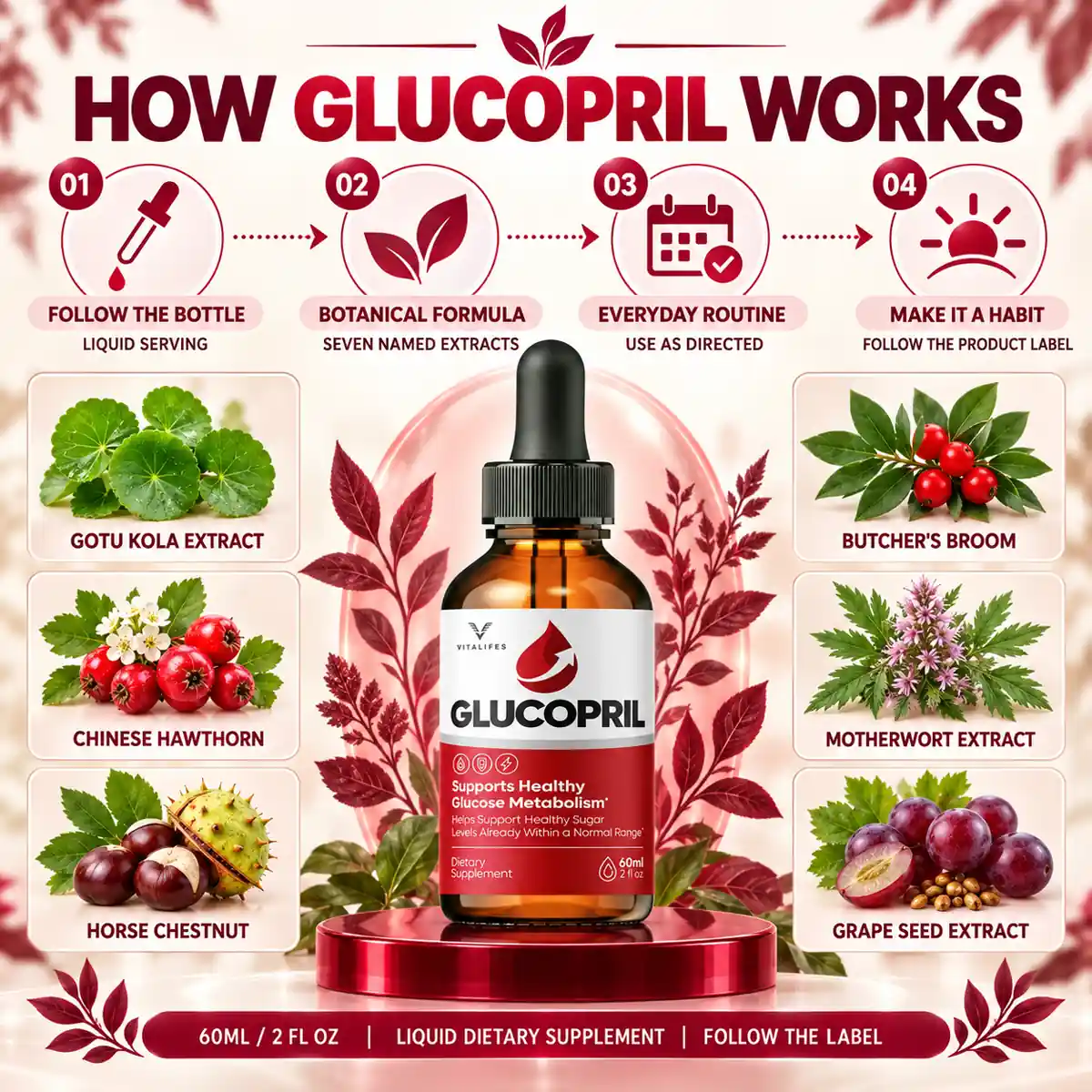
- This bottle holds 60 mL and the instruction is two drops daily after a meal.
- Converting that into days-per-bottle requires knowing how many drops make up a millilitre, and that figure is not printed on this label.
- Pharmacy practice commonly assumes roughly 20 drops per millilitre for a thin, water-based liquid, but glycerin-based and other viscous liquids typically deliver noticeably fewer drops per millilitre.
- At 20 drops/mL, 60 mL and two drops a day works out to roughly 600 days of supply from one bottle; at a more viscous 12 drops/mL, the same bottle works out to roughly 360 days.
- Neither number is a claim about this specific bottle's actual drop size, which nobody outside the factory can state precisely without measuring it directly.
The instruction, read exactly as printed
The label direction for this product is two drops daily, taken after a meal, from a 60 mL amber glass bottle with a pipette built into the cap. That is the entire printed serving instruction: no servings-per-container figure, no days-supply estimate, no cautionary note about counting drops precisely. It is, on its face, about as simple an instruction as a supplement label can carry.
The simplicity is real for the person taking it — two drops is easy to remember and hard to double by accident. It becomes less simple the moment anyone tries to answer a related, entirely reasonable question: how many days will one bottle actually last, and what does that make the cost per day?
The one number a drop-dosed liquid never prints
A capsule or tablet answers the days-supply question by definition: the label states servings per container, and dividing by servings per day gives days per bottle without any further assumption. A liquid dosed by volume — a millilitre marked on a syringe, for instance — works the same way. A liquid dosed by drops does not, because a drop is not a standard unit of volume. It is whatever volume the liquid's surface tension and the dropper orifice's diameter happen to produce together, and that varies by liquid.
This bottle's label states the bottle volume (60 mL) and the daily serving (two drops), but not the number of drops per millilitre — which is the one figure that would let a reader convert directly from one to the other. That is not unusual for this product category; it is simply the gap this article works through explicitly rather than skipping past.
Running the arithmetic at two different assumptions
Pharmacy practice has long used a rough rule of thumb that a standard dropper delivers approximately 20 drops per millilitre for a thin, water-like liquid — a convention useful for rough estimation, not a guaranteed figure for any specific bottle or formulation. Since this product's own carrier is described on its ingredients page as most likely vegetable glycerine, a food-grade alcohol, purified water or some blend of the three, and glycerin-based liquids are markedly more viscous than water, the real per-millilitre drop count for this specific bottle could sit meaningfully below that thin-liquid convention. The table below runs the arithmetic at two illustrative assumptions to show how much the answer moves.
| Assumption | Drops in 60 mL | Days per bottle at 2 drops/day |
|---|---|---|
| ~20 drops/mL (thin, water-like liquid convention) | ~1,200 drops | ~600 days |
| ~15 drops/mL (a middling assumption) | ~900 drops | ~450 days |
| ~12 drops/mL (a more viscous, glycerin-leaning liquid) | ~720 drops | ~360 days |
All three rows are illustrative arithmetic built on assumed drops-per-millilitre figures, not a measurement of this specific bottle. The true figure for this product has not been independently verified by this desk.
The spread between the highest and lowest estimate in that table is not a rounding error — it is the difference between roughly a year of supply and roughly ten months from the identical bottle, depending entirely on an assumption about drop size that the label itself does not resolve.
Order GlucoPril with the drop-count arithmetic in front of you
A 60 mL bottle, two drops daily after a meal, and a website that shows the assumption behind every days-supply estimate rather than stating one as fact.
Price at checkout · one payment, no subscription · money-back guarantee as printed at the checkout
Order GlucoPril On The Official Website2 drops a day after a meal · 60 ml a bottle · lot GLU-26/GL-2779
Why drop size varies by liquid, not just by dropper
Three physical factors decide how large a single drop is: the diameter of the opening the liquid falls through, the liquid's surface tension, and its viscosity (how thick or resistant to flow it is). A thin, water-based liquid forms smaller, more numerous drops from a given orifice than a thicker, more viscous one does, because the thicker liquid's higher resistance to flow tends to let larger drops accumulate before gravity pulls them free. This is a basic property of fluids, not a manufacturing defect, and it is the reason a single rule of thumb cannot cover every dropper bottle on a supplement shelf.
Two consequences follow. First, a days-supply figure calculated from a generic drops-per-millilitre assumption is always an estimate, never a guarantee, for any specific liquid supplement. Second, the only way to know a specific bottle's actual figure with confidence is to count directly — measuring how many drops it actually takes to fill a small measured volume, or timing how many days a bottle in regular use actually lasts.
How this compares with a capsule or tablet schedule
It is worth setting this uncertainty against the alternative format directly. A capsule-based supplement states servings per container on the label as a simple integer — sixty capsules, thirty-day supply, two a day — and that number requires no assumption about droplet physics to use. A liquid dosed by drops trades that certainty for a different convenience: a 60 mL bottle is compact, and two drops is a serving nobody accidentally doubles by miscounting capsules from a full-handed pour.
Neither format is objectively better; they simply carry different kinds of uncertainty. A capsule count can still hide an unclear serving size in milligrams per capsule, which is a problem this website raises elsewhere for this bottle's ingredient list. A drop count trades that problem for an uncertain volume per unit. Reading past either format to the actual number behind it is the same exercise either way.
What to actually do with an unmeasured bottle
Three practical options, in order of effort.
The simplest is to track calendar days directly: mark the date a bottle is opened, and mark the date it runs dry. After one bottle, that gives a real, bottle-specific days-supply figure rather than an estimate, and it is the only method that requires no assumption about drop physics at all.
The next is a direct count: using a small kitchen or lab measuring tool, count how many drops from this specific bottle fill 1 mL, and scale that figure to the full 60 mL. This resolves the uncertainty in the table above precisely, for this bottle, in a few minutes.
The least precise but fastest option is to use the illustrative range in the table above as a planning bracket — somewhere between roughly ten and twelve months per bottle — when deciding how many bottles to order at once, while treating the exact figure as unresolved until measured directly.
A single days-supply figure printed as fact, without the assumption behind it, would be exactly the kind of unstated precision this site criticises elsewhere on this label. Showing the range, and the physical reason for the range, is the more honest version of the same information.
What this means for planning a pack size
Anyone deciding between a one-bottle trial and a multi-bottle pack is, in effect, making a bet about a days-supply figure this label does not resolve. The illustrative range above — roughly ten months to a year per bottle, depending on drop size — is wide enough that it is worth treating any specific figure quoted elsewhere, on this site or anywhere else, as an estimate rather than a guarantee, and worth confirming with a direct count or a calendar log once a bottle is actually in hand.
It is also worth noting what this arithmetic does not tell anyone: nothing here is a claim about whether the product works, only about how long a bottle of it is likely to last once opened. The twelve-week tracking method covered elsewhere on this site addresses the separate, more important question of whether taking it produced any measurable change at all, and that question does not depend on getting the drops-per-millilitre arithmetic exactly right.
A worked example of the direct-count method
To make the second option above concrete: a kitchen dropper or a graduated 1 mL syringe, either of which is inexpensive and widely available, lets anyone count drops directly. Fill the syringe to the 1 mL mark by counting drops from the bottle's own dropper cap into it, note the count, and repeat two or three times to average out any variation between individual drops. Multiply that per-millilitre count by 60 to get total drops in a full bottle, then divide by two (the daily serving) to get days-per-bottle specific to that exact bottle, that exact dropper, and that exact liquid.
This five-minute exercise resolves the entire uncertainty this article has been discussing, for the one bottle actually measured. It will not necessarily match another buyer's bottle exactly, since minor manufacturing variation in the dropper orifice or small batch-to-batch differences in the carrier liquid’s viscosity could shift the count slightly — but it will be far closer to the truth than any generic rule of thumb, including the ones in the table above.
Why cost-per-day claims deserve the same scrutiny
Any cost-per-day figure quoted for a drop-dosed liquid supplement inherits the same uncertainty this article has walked through for days-supply, because the two figures are the same arithmetic viewed from different sides. A marketing page that states a specific cost-per-day number without stating its drops-per-millilitre assumption is making exactly the kind of unstated-precision claim this website flags elsewhere on this bottle's ingredient panel. The fix is identical: ask what assumption sits behind the number, and treat the number as an estimate until it has been checked against a real bottle.
Three questions for any drop-dosed supplement
- Does the label state drops per millilitre, or only bottle volume and daily serving? Most drop-dosed labels, including this one, state the latter and leave the conversion to the reader.
- Is the carrier liquid thin or viscous? A glycerin-heavy liquid delivers noticeably fewer, larger drops per millilitre than a thin, water-based one.
- Has anyone actually counted this specific bottle? Until someone has, any days-supply figure is an estimate built on an assumption, not a measurement.
On this bottle, the honest answers run: no stated conversion, a likely viscous carrier based on the ingredients page's own description, and no independently verified count from this desk. The how-to-use page covers the serving instruction itself in more detail.