GlucoPril Official Website › Blog › Motherwort
Motherwort: The One Trial Behind The Label
Search engine boxes fill with motherwort content about spiritual meaning, witchcraft and folk protection. Underneath all of that sits exactly one published human trial: fifty patients, twenty-eight days, a dose that can be stated precisely. Here is that trial in full, and what an in-vitro receptor study adds to explain it.
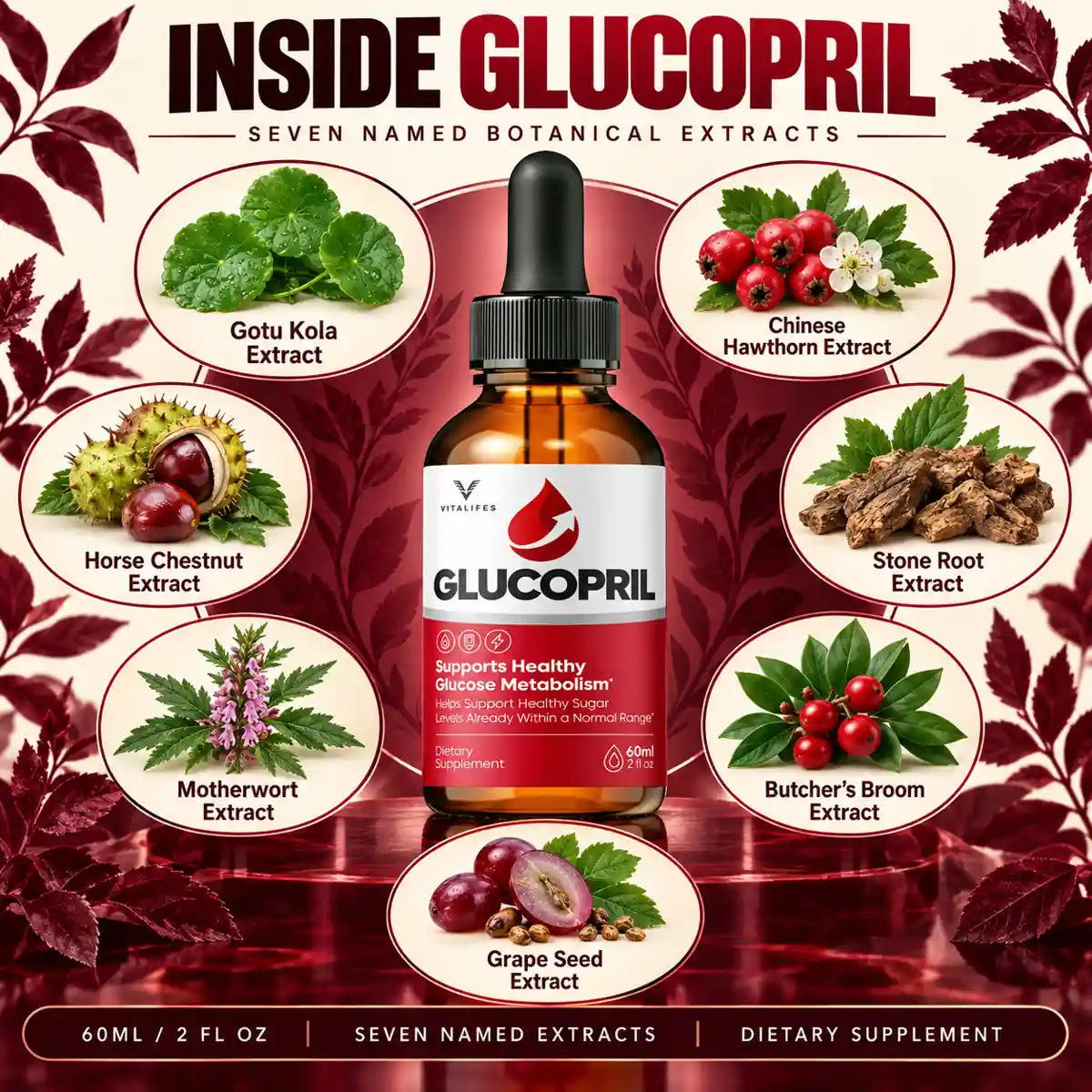
- Motherwort is Leonurus cardiaca, traditionally used as a cardiotonic and for anxiety, sleep and gynaecological complaints.
- PubMed indexes exactly one randomised or open clinical trial of it in humans: fifty patients, 1200 mg of a Leonurus oil extract a day, for 28 days.
- That trial studied people with high blood pressure and coexisting anxiety and sleep disturbance, not blood glucose.
- A separate laboratory study found the extract binds to the GABA site on a receptor linked to anxiety, giving a plausible mechanism for the calming effect the trial reported.
- No trial, human or animal, in the indexed literature has tested motherwort against a glucose or HbA1c outcome.
What motherwort is, and what it has been used for
Leonurus cardiaca is a tall, coarse perennial in the mint family, native to central Asia and long naturalised across Europe and North America. Its common name and its species name both point to the same traditional reputation: cardiaca for the heart, motherwort for childbirth and women’s complaints. Historically it has been used as a mild sedative, a remedy for heart palpitations that were not linked to structural disease, and for amenorrhea, dysmenorrhea and the anxiety that can accompany menopause.
A 2019 review updating the European Medicines Agency’s 2010 assessment of the herb summarises this traditional-use case and the research published since. It is a useful document precisely because it is candid about the gap: motherwort has centuries of traditional use and, at the time of that review, still very little modern trial evidence to stand alongside it.
This label names Motherwort Extract without specifying which part of the plant or how it was standardised. The traditional and research material is the aerial parts — the above-ground leaf, stem and flower — harvested at flowering, which is the presumed source here though the label does not say so.
Fifty patients, twenty-eight days
A search of the published, indexed literature for a randomised or controlled human trial of motherwort turns up one result. A 2011 study in Phytotherapy Research, run by a Russian and Saint-Petersburg-based team, opens by naming the problem directly: despite motherwort’s traditional reputation, clinical data on its effect in patients was lacking. The trial was designed to start filling that gap.
Fifty patients with stage 1 or stage 2 arterial hypertension, all with coexisting anxiety and sleep disturbance, were treated for 28 days with a Leonurus oil extract at 1200 mg a day. The design description in the indexed abstract does not state a placebo arm, so this is best read as an open clinical study of response over time rather than a blinded, placebo-controlled trial in the mould of the Cochrane hawthorn or hesperidin-chalcone reviews cited elsewhere on this site.
What it found: improvement in psycho-emotional status and blood pressure appeared about a week earlier in the stage 1 patients than the stage 2 patients. Using the Clinical Global Impression scale, a standard psychiatric rating tool, 32 per cent of patients showed significant improvement in anxiety and depression symptoms, 48 per cent showed moderate improvement, 8 per cent a weak effect, and 12 per cent did not respond. Side effects were minimal across all groups.
| What the label names | What the one trial used | Why the difference matters |
|---|---|---|
| Motherwort Extract, plant part not stated | Leonurus oil extract, aerial parts, 1200 mg a day, for 28 days | The only human dose on record is for a specific extract form at a specific amount, taken alone |
| Fifth of seven extracts, blend total near 121 mg | 1200 mg a day of motherwort alone | The single-ingredient trial dose is roughly ten times the entire seven-plant blend total |
| Two drops of a liquid, after a meal | An oil extract, dosed daily, in patients under clinical observation | Same broad oral route; different form, schedule and population |
The left column is read off the seller's own ingredient graphic. The middle column is what the one published study used, not a prediction about this bottle.
Order GlucoPril with the motherwort arithmetic in front of you
Seven named botanical extracts, two drops a day after a meal, and a website that prints what each plant’s one trial or ten measured rather than what a front panel implies.
Price at checkout · one payment, no subscription · money-back guarantee as printed at the checkout
Order GlucoPril On The Official Website2 drops a day after a meal · 60 ml a bottle · lot GLU-26/GL-2779
Why it might do that: a receptor study
A single open clinical study is a starting point, not a mechanism, and it is worth knowing what laboratory work exists alongside it. A 2015 study tested standardised Leonurus cardiaca and the related Leonurus japonicus for their effect on rat GABAA receptors, the same receptor system that benzodiazepine anti-anxiety medicines act on.
The L. cardiaca extract inhibited binding at the GABA site with an IC50 of 21 micrograms per millilitre, a meaningfully high binding affinity in this kind of assay, while binding at the separate benzodiazepine site was 15 to 30 times weaker. That is a plausible pharmacological story for why a motherwort extract might calm an anxious patient: it appears to interact with the same neurotransmitter site as established anti-anxiety medicines, through a different part of the receptor than those medicines use.
A receptor-binding assay in isolated tissue is not proof that a swallowed dose reaches the brain at an active concentration, and the study’s authors are explicit that the compound responsible for the effect in L. cardiaca specifically remains unidentified — unlike its relative L. japonicus, where a known constituent explained the activity. What the assay does is make the 2011 clinical result less surprising than it would otherwise be.
Setting 1200 mg beside this bottle
Marketplace reports describe the actives in this formula grouped in a proprietary blend of about 121 mg, for all seven plants combined. The one human trial of motherwort used 1200 mg a day of that plant alone — nearly ten times the entire blend total, for one ingredient.
This is the widest gap of any ingredient covered on this site so far. Even granting motherwort the whole of the blend, which the ingredient list rules out by definition, the amount would fall roughly an order of magnitude short of the dose the only clinical study used.
The seller names seven extracts and gives a weight for none of them. A figure nobody published cannot be invented, so every ingredient on this site carries the dose its own research used instead. For motherwort, that dose happens to make the gap unusually easy to see.
How the research lines up with this label
| What the research used | What this label carries | The gap |
|---|---|---|
| 1200 mg/day of a Leonurus oil extract, aerial parts, 28 days | No amount printed, one of seven extracts | Nothing on the label can be set against the trial figure directly |
| An open clinical study, no stated placebo arm, in a specific patient population | Sold to a general adult population on a glucose-metabolism claim | The one trial's design and its population were both narrow |
| Outcomes: anxiety and depression symptom scores, blood pressure | Marketed for blood sugar support | The measured outcome and the marketed outcome are unrelated systems |
| A GABA-receptor binding study explaining a calming effect | No mechanism for a glucose effect proposed or tested anywhere in the literature | The one mechanistic thread that exists points away from glucose, not toward it |
The first column is read off the published research. The second is read off the seller’s artwork. The third is what a buyer is left holding.
What is on the safety record
The 2011 trial reported minimal side effects across all treatment groups, which is reassuring as far as it goes for a 28-day course at 1200 mg a day. It is one trial, and the traditional-use literature the EMA review summarises carries an older and more specific caution: motherwort’s traditional gynaecological uses — bringing on a delayed period, easing painful periods — describe an effect on the uterus, which is the standard reason herbal references advise against motherwort in pregnancy.
- The one clinical trial reported minimal side effects at 1200 mg a day for 28 days.
- Traditional use for delayed or painful periods points to uterine activity, which is why pregnancy is the standard caution for this plant.
- No drug-interaction study of motherwort was found in this search; anyone on a sedative, anti-anxiety or blood pressure medicine should raise it with a prescriber first.
- The label direction for this product covers all seven plants at once: for healthy adults, not for pregnancy or nursing.
“Dietary supplement. For adults. Follow the directions printed on the bottle and keep it out of reach of children.” That is the full extent of the printed caution, and it is the same sentence this category prints everywhere.
What to make of it on this bottle
Motherwort is an honest case of a plant whose folklore vastly outpaces its clinical record. One open trial, fifty patients, a specific population and a specific extract, is what exists. It is a real, positive, and reasonably interesting result — not nothing, and also not the kind of ten-trial pooled evidence that this site’s article on the vein-and-capillary plants can point to for some of the other six names on this label.
None of that trial, and none of the receptor study that helps explain it, touches blood glucose. If this bottle is being taken for its front-of-pack claim, motherwort is not the ingredient doing the explaining, whatever the search engines suggest about its other reputations.
References
- Shikov AN, Pozharitskaya ON, Makarov VG, Demchenko DV, Shikh EV. Effect of Leonurus cardiaca oil extract in patients with arterial hypertension accompanied by anxiety and sleep disorders. Phytother Res. 2011;25(4):540-3. PMID 20839214. https://pubmed.ncbi.nlm.nih.gov/20839214/
- Rauwald HW, Savtschenko A, Merten A, Rusch C, Appel K, Kuchta K. GABAA Receptor Binding Assays of Standardized Leonurus cardiaca and Leonurus japonicus Extracts as Well as Their Isolated Constituents. Planta Med. 2015;81(12-13):1103-10. PMID 26218338. https://pubmed.ncbi.nlm.nih.gov/26218338/
- Fierascu RC, Fierascu I, Ortan A, Fierascu IC, Anuta V, Velescu BS, Pituru SM, Dinu-Pirvu CE. Leonurus cardiaca L. as a Source of Bioactive Compounds: An Update of the European Medicines Agency Assessment Report (2010). Biomed Res Int. 2019;2019:4303215. PMID 31119169. https://pubmed.ncbi.nlm.nih.gov/31119169/